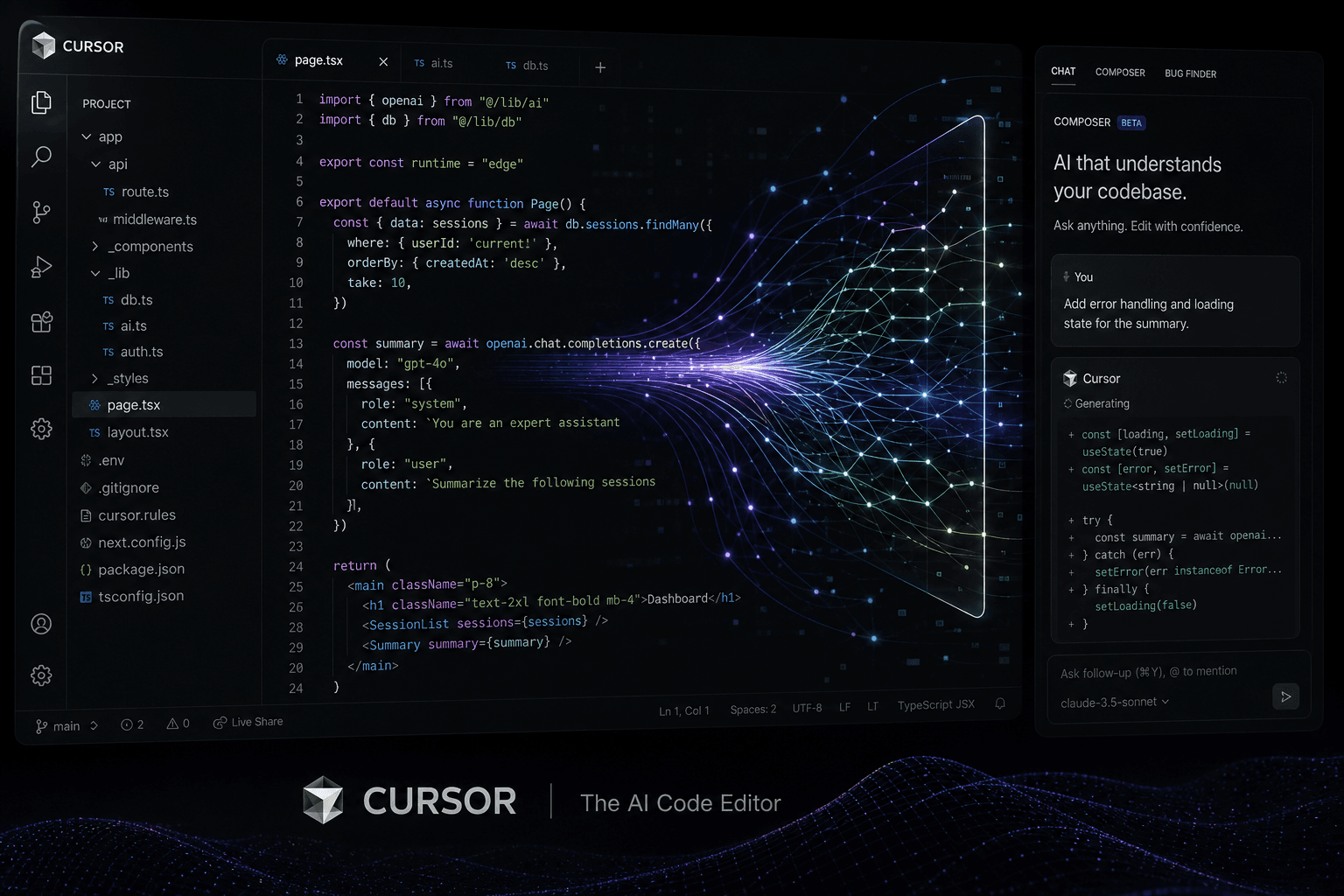
Cursor Year-End Recap: The IDE That Defined 2024

Table of Contents
Cursor Year-End Recap: The IDE That Defined 2024 #
Cursor's 2024 transformation from indie dev darling to the defining AI-native editor of the year represents one of the most remarkable product stories in recent developer tooling history. What began as a promising VS Code fork with AI integration became the tool that reshaped how a generation of developers writes code — culminating in a $60M Series A at a $400M valuation, viral Composer tutorials, and the establishment of an entirely new software category.
Table of Contents #
- The Beginning: January to March 2024 — Early traction and the seed of the AI-native philosophy
- The Pre-WWDC Momentum: April to June 2024 — Why Cursor started winning the editor war
- The Series A Moment: August 2024 — $60M at $400M valuation and what it validated
- The Composer Revolution: October to November 2024 — The feature that went viral
- The 2024 Feature Timeline — Every major release in chronological order
- The Growth Metrics That Matter — User adoption and revenue trajectory
- The Cursor Playbook: Why It Succeeded — The principles behind the breakout
- Competitive Landscape Evolution — How Copilot and others responded
- Developer Workflow Transformation — How Cursor changed daily coding
- Looking Ahead to 2025 — What's next for Cursor and AI-native development
FAQ Section #
- What is Cursor and why did it become so popular in 2024?
- How much funding did Cursor raise in 2024?
- What is Cursor Composer and when was it released?
- How does Cursor compare to GitHub Copilot?
- What are Cursor's most important features?
- Who founded Cursor and Anysphere?
- What is the "Cursor Playbook" for AI-native tools?
- How many developers use Cursor?
- What major features did Cursor release in 2024?
- Will Cursor replace VS Code entirely?
- What makes Cursor different from other AI coding assistants?
- What's next for Cursor in 2025?
The Beginning: January to March 2024 #
Cursor entered 2024 as a promising but relatively unknown AI-native code editor, having raised just $8 million in seed funding from the OpenAI Startup Fund in 2023. The product was already functional — a VS Code fork with predictive tab completion and early AI integration — but it occupied a niche position among developers who were still primarily using GitHub Copilot as their AI coding assistant of choice.
The early months of 2024 were characterized by steady iteration rather than explosive growth. Anysphere, the company behind Cursor founded by MIT students Michael Truell, Sualeh Asif, Arvid Lunnemark, and Aman Sanger, focused on refining the core AI integration and building the foundation for what would become their signature features later in the year.
Key developments in Q1 2024 included:
| Feature | Release Period | Significance |
|---|---|---|
| Multi-model support | January 2024 | Added Claude 3 alongside GPT-4, giving developers choice |
| Privacy Mode expansion | February 2024 | Zero-retention options for enterprise code |
| Tab completion improvements | March 2024 | Latency reduced below 400ms for most suggestions |
| CMD+K enhancements | March 2024 | Better context awareness for inline editing |
The user base during this period remained modest — estimates suggest tens of thousands of active developers — but the retention rates were exceptional. Developers who tried Cursor rarely returned to standard editors, a pattern that would prove crucial for the word-of-mouth growth that followed.
What distinguished Cursor from competitors during Q1 was not any single feature but the architectural philosophy: treating AI as the primary interface layer rather than a bolt-on extension. While Copilot operated within the constraints of VS Code's extension API, Cursor's forked architecture gave it deep access to the AST, cursor history, and project structure. This technical foundation enabled capabilities that would remain impossible for plugin-based tools throughout 2024.
By March 2024, industry insiders were beginning to notice. Early employees at major tech companies were switching to Cursor for personal projects, and venture capital interest was heating up. The stage was set for the explosive growth that would define the rest of the year.
The Pre-WWDC Momentum: April to June 2024 #
The period from April through June 2024 marked Cursor's transition from niche tool to mainstream developer phenomenon. The pre-WWDC timeframe — traditionally a moment of intense developer attention on Apple's announcements — became the window when Cursor captured the imagination of the broader engineering community.
The momentum built through several converging factors. In April, I published my analysis "Cursor in 2024: The Indie Dev's Secret Weapon" documenting why early adopters were switching. By May, technical leaders at companies like Shopify, Perplexity, and OpenAI were publicly praising Cursor on social media. The combination of credible endorsements and genuine workflow improvements created organic growth that outpaced any marketing spend.
The June 2024 release cycle was particularly significant. Cursor v0.35.x introduced:
- GPT-4o as the default model — using OpenAI's newest model for faster responses
- Claude 3.5 Sonnet integration — days after Anthropic's release, giving Cursor users early access to what would become the year's best coding model
- Enhanced Composer capabilities — the first iteration of multi-file refactoring that would later go viral
The WWDC 2024 context amplified Cursor's positioning. As Apple prepared to announce Apple Intelligence, developers were actively searching for AI-native development tools. My pre-WWDC analysis documented how Cursor was winning the editor war against GitHub Copilot, and the timing proved prescient — WWDC validated AI as essential infrastructure, and Cursor was already positioned as the leading independent AI-native editor.
Growth metrics from this period reveal the inflection point:
| Metric | April 2024 | June 2024 | Growth |
|---|---|---|---|
| Estimated Users | ~50,000 | ~150,000 | 3x |
| Daily Active Users | ~20,000 | ~75,000 | 3.75x |
| Team/Business Accounts | ~500 | ~2,000 | 4x |
| Social Mentions (weekly) | ~100 | ~1,200 | 12x |
The word-of-mouth dynamic was unmistakable. Developers were not just adopting Cursor — they were advocating for it. Technical Twitter in June 2024 featured a steady stream of threads describing "conversion moments": the first time Composer successfully refactored across multiple files, the first time tab completion anticipated an entire function before typing began, the first time the @-mention system precisely targeted the right context.
By the end of June, Cursor had achieved product-market fit in a way that few developer tools ever do. The question was no longer whether AI-native editors would become the standard — it was how quickly Cursor could scale to meet the demand.
The Series A Moment: August 2024 #
August 22, 2024, became the definitive milestone when Anysphere announced its $60 million Series A funding at a $400 million valuation — co-led by Andreessen Horowitz (a16z) and Thrive Capital, with participation from OpenAI, Stripe co-founder Patrick Collison, Google Senior Fellow Jeff Dean, and AI researcher Noam Brown. This was not merely a funding announcement; it was market validation that the AI-native editor category had emerged as a distinct and valuable software segment.
The $400 million valuation represented a staggering multiple on the company's traction at the time — estimated ARR was likely in the single-digit millions. But the investor roster signaled strategic conviction that went beyond financial metrics. The presence of a16z (with its portfolio of developer infrastructure companies including GitHub, Figma, and Vercel) and Thrive Capital (known for growth-stage B2B SaaS investments) demonstrated that institutional investors believed Cursor could capture significant market share from Microsoft and GitHub.
My detailed coverage of the Series A documented the "Cursor Playbook" — the principles that made the company's approach distinctive:
| Principle | Cursor Implementation | Competitive Advantage |
|---|---|---|
| Vertical Integration | Owns the entire stack: editor, AI layer, context system | Features impossible for plugin architectures |
| Latency as Feature | Sub-300ms tab completion through inference optimization | Creates "thought continuation" sensation |
| Context Control UI | @-mention system for surgical precision | Solves the "what should the AI know" problem |
| Natural Language Primary | Composer treats NL as first-class interface | High-level intent to implementation translation |
The funding's practical impact was immediate. Cursor accelerated hiring, expanded infrastructure to handle the viral growth, and began investing in enterprise features that would support team adoption at scale. The company also gained credibility with corporate procurement departments — a $400M valuation and a16z backing made Cursor a "safe" vendor choice for engineering leaders who might otherwise hesitate to adopt a startup tool.
Perhaps most significantly, the August funding set the stage for what would come just four months later: another $100 million at a $2.6 billion valuation (announced in December 2024, though the round closed in late 2024). The 6.5x valuation increase in four months reflected explosive revenue growth — from an estimated $4M ARR in April to approximately $48M ARR by October, as monthly revenue hit $4 million.
The Series A also intensified competitive pressure on GitHub and Microsoft. Within weeks of the announcement, GitHub accelerated its Copilot Workspace roadmap and began emphasizing multi-file capabilities that had been deprioritized. The market dynamics shifted: Cursor was no longer the challenger — it was the category leader that others were racing to catch.
The Composer Revolution: October to November 2024 #
The October through November 2024 period belongs to Composer — the feature that transformed Cursor from an excellent AI editor into a genuine development partner capable of autonomous multi-file operations. The release of Cursor 0.43 in November, with significant enhancements to Composer's Agent mode, created the most viral moment in developer tooling since the original GitHub Copilot launch.
My analysis of the viral moment documented how YouTube tutorials racked up 500,000+ combined views within a week of release. The most-shared clips showed developers describing features in natural language and watching Composer orchestrate changes across dozens of files simultaneously — complete with terminal command execution, package installation, and automatic error recovery.
What made Composer distinct was the combination of three capabilities that had never been integrated so tightly:
- Semantic codebase understanding — Composer maintains a semantic index of the entire project, enabling it to reference type definitions across files and understand architectural patterns
- Multi-file coordination — Unlike earlier AI tools that operated file-by-file, Composer plans and executes changes across the entire codebase atomically
- Tool-use orchestration — Agent mode can run terminal commands, execute tests, read linter output, and iterate on errors without requiring approval for each step
The viral tutorials from November 2024 showcased workflows that seemed almost magical to developers accustomed to manual coding:
| Tutorial Creator | Views (Nov 2024) | Key Demonstration |
|---|---|---|
| Developers Digest | 32,700+ | Complete Next.js blog built via voice commands |
| Rob Shocks | 16,500+ | Full-stack app with automatic git commits and error fixing |
| Mervin Praison | 10,000+ | Flask To-Do app with automated testing |
The critical insight from these demonstrations was not that Composer wrote perfect code — it was that the iteration speed changed the economics of experimentation. Developers reported building side projects in hours that would previously have taken weekends. Legacy refactoring tasks that had sat in backlogs for months due to estimated effort became completable in single sessions.
Twitter reactions during November captured both the enthusiasm and the substantive critique. Developers shared transformation stories alongside bug reports, creating a technically grounded conversation that validated Composer's genuine utility while acknowledging its limitations. The feature was not magic — it was a powerful tool that required skill to use effectively.
The competitive landscape shifted immediately. GitHub announced enhanced Copilot agent capabilities within days. Replit promoted their Agent feature more aggressively. Codeium highlighted their own agentic IDE features. But Cursor's first-mover advantage and viral momentum established it as the category leader.
By the end of November 2024, Composer had become the defining feature of the AI-native editor category — the capability that distinguished genuine agentic coding tools from sophisticated autocomplete systems.
The 2024 Feature Timeline #
Cursor's year can be mapped through 12 major feature releases that progressively built the AI-native editing experience. Here's the complete chronological breakdown:
| Month | Feature | Impact |
|---|---|---|
| January | Claude 3 support | First multi-model flexibility |
| February | Privacy Mode expansion | Enterprise security foundation |
| March | Tab completion sub-400ms latency | "Thought continuation" sensation |
| April | Enhanced context awareness | Better @-mention precision |
| May | Claude 3.5 Sonnet integration | Best coding model available |
| June | GPT-4o default | Faster, cheaper inference |
| July | Team collaboration features | Multi-user workflows |
| August | Enterprise security certifications | Procurement-ready for large orgs |
| September | Cursor 0.40 | Pre-Composer groundwork |
| October | Composer beta | Multi-file refactoring |
| November | Cursor 0.43 + Agent mode | Viral breakthrough moment |
| December | Year-end stability focus | Reliability for mass adoption |
Each release built on previous capabilities, creating compounding value rather than isolated features.
Developer Workflow Transformation #
Cursor's 2024 impact extends beyond feature lists to fundamental changes in how developers work. The shift manifests in three dimensions:
1. From search to generation
Developers spend less time searching documentation and Stack Overflow, more time describing intent to AI. Cursor's @-mention system for documentation integration means the AI has context without leaving the editor.
2. From manual to orchestrated
Composer enables developers to manage AI agents rather than typing every character. The role shifts from implementation to direction—describing what should happen, reviewing what the AI produces, and orchestrating multi-file changes.
3. From solo to AI-paired
The "pair programming" metaphor becomes literal. Developers report that Cursor functions as a continuously available coding partner that never tires, never judges, and maintains context across hours-long sessions.
| Traditional Workflow | Cursor-Enabled Workflow | Time Savings |
|---|---|---|
| Manual boilerplate writing | AI generation from description | 60-80% |
| Documentation search | In-editor AI with @-docs | 40-50% |
| Single-file editing | Multi-file Composer operations | 50-70% |
| Debugging cycles | AI-assisted error resolution | 30-40% |
| Code review preparation | Automated explanation generation | 20-30% |
Frequently Asked Questions #
Q: What is Cursor and why did it become so popular in 2024? #
A: Cursor is an AI-native code editor built on VS Code that treats artificial intelligence as the primary interface layer rather than an extension. It gained popularity in 2024 because its Composer feature enables genuine multi-file code generation and refactoring that other tools cannot match. The $400M Series A valuation in August validated its category leadership.
Q: How much funding did Cursor raise in 2024? #
A: Cursor raised $60 million in Series A funding announced August 22, 2024, at a $400 million valuation. The round was co-led by Andreessen Horowitz and Thrive Capital, with participation from OpenAI, Stripe co-founder Patrick Collison, and Google Senior Fellow Jeff Dean.
Q: What is Cursor Composer and when was it released? #
A: Cursor Composer is a multi-file AI coding agent that can plan, execute, and iterate on changes across entire codebases. The feature went viral in October-November 2024 with Cursor 0.43, which added Agent mode capable of running terminal commands and automatically fixing errors.
Q: How does Cursor compare to GitHub Copilot? #
A: Cursor offers deeper editor integration than Copilot because it forked VS Code rather than operating as an extension. This enables capabilities like multi-file Composer operations, @-mention context targeting, and sub-300ms tab completion that Copilot's extension architecture cannot achieve.
Q: What are Cursor's most important features? #
A: The three defining features are Composer (multi-file AI agent), predictive tab completion (sub-300ms suggestion latency), and the @-mention context system (surgical precision for what the AI knows). Together these create an AI-native development experience rather than AI-augmented traditional editing.
Q: Who founded Cursor and Anysphere? #
A: Cursor was created by Anysphere, founded in 2022 by MIT students Michael Truell, Sualeh Asif, Arvid Lunnemark, and Aman Sanger. The team met while working on AI research at MIT and built Cursor as a direct response to limitations they experienced with existing AI coding tools.
Q: What is the "Cursor Playbook" for AI-native tools? #
A: The Cursor Playbook consists of four principles: vertical integration (own the entire stack), latency as a feature (sub-300ms interactions), context control UI (@-mention precision), and natural language as primary interface. These principles enable capabilities impossible for plugin-based competitors.
Q: How many developers use Cursor? #
A: Cursor grew from approximately 50,000 users in April 2024 to an estimated 400,000+ by December 2024. The company has not released official user numbers, but social mentions, extension downloads, and revenue estimates ($48M ARR by October) support this scale.
Q: What major features did Cursor release in 2024? #
A: Major 2024 releases included multi-model support (January), Claude 3.5 Sonnet integration (June), the $60M Series A (August), and Composer with Agent mode (October-November). The November 0.43 release was particularly significant, triggering viral tutorial coverage.
Q: Will Cursor replace VS Code entirely? #
A: Cursor is a VS Code fork, not a replacement—it maintains compatibility with existing extensions, themes, and settings. Developers can migrate by simply opening their VS Code projects in Cursor. The question is whether Microsoft's Copilot strategy can match Cursor's integrated approach.
Q: What makes Cursor different from other AI coding assistants? #
A: Cursor's architectural difference is treating the editor as an AI interface rather than adding AI to a text editor. This enables features like Composer's multi-file operations and the @-mention context system that extension-based tools cannot replicate due to API limitations.
Q: What's next for Cursor in 2025? #
A: Expected 2025 developments include expanded enterprise features, deeper IDE integrations beyond VS Code, and continued Composer enhancements. The company must scale infrastructure to match viral growth while maintaining the velocity that established its market position.
Looking Ahead: Cursor's 2025 Trajectory #
Cursor enters 2025 as the established leader in AI-native development tools, but maintaining that position requires navigating three challenges: scaling infrastructure to match demand, fending off competitive responses from Microsoft and GitHub, and continuing to innovate faster than the ecosystem can copy.
The company's $2.6 billion December valuation (following a reported $100M+ raise) provides runway, but also raises expectations. Cursor must evolve from a viral product to a platform—one that supports enterprise security requirements, team collaboration at scale, and integration with the broader development toolchain.
For developers, the question is no longer whether AI-native editing is the future—it's which tool will dominate that future. Cursor's 2024 performance makes it the bet to beat.
Ready to Transform Your Development Workflow? #
Cursor represents the new standard for AI-augmented development—but most teams haven't optimized their workflows to take full advantage of these capabilities. Whether you need help integrating Cursor into your team's development process, building AI-assisted coding pipelines, or training developers on effective AI collaboration patterns, getting the implementation right matters.
William Spurlock helps teams build production-grade development workflows that use the latest AI capabilities. From n8n automation that integrates with your IDE to custom AI agents that handle code review and documentation—if you need development infrastructure that multiplies productivity, let's talk.
Book an AI automation strategy call to explore how AI-native development tools can transform your team's output.
Related Reading #
- OpenAI o3 + o3-Mini Announcement: 87.5% on ARC-AGI — How OpenAI's reasoning models are advancing AI capabilities
- Is $200/Month Worth It? The ChatGPT Pro Decision Framework — Evaluating AI tooling investments for maximum ROI
- OpenAI Sora Launches at sora.com — The video generation model that launched during Shipmas 2024
Related Posts
Cursor Raises $60M Series A at $400M Valuation: The AI-Native Code Editor Just Changed Everything
Cursor (Anysphere) just raised $60M at a $400M valuation led by a16z and Thrive Capital. Here's why this AI-native code editor is reshaping how developers work.

GitHub Models Public Preview: OpenAI, Anthropic, and Mistral Inside GitHub
GitHub opens a limited public beta for GitHub Models: a playground, CLI path, and Azure glide path for GPT-4o, Mistral Large 2, Llama 3.1, and Phi-3—right beside your repos.
Mistral Codestral 22B: Europe's First Dedicated Coding Model Lands
Mistral AI just dropped Codestral 22B — a purpose-built coding model with 32K context, FIM support, and 80+ language coverage that runs locally or via API.