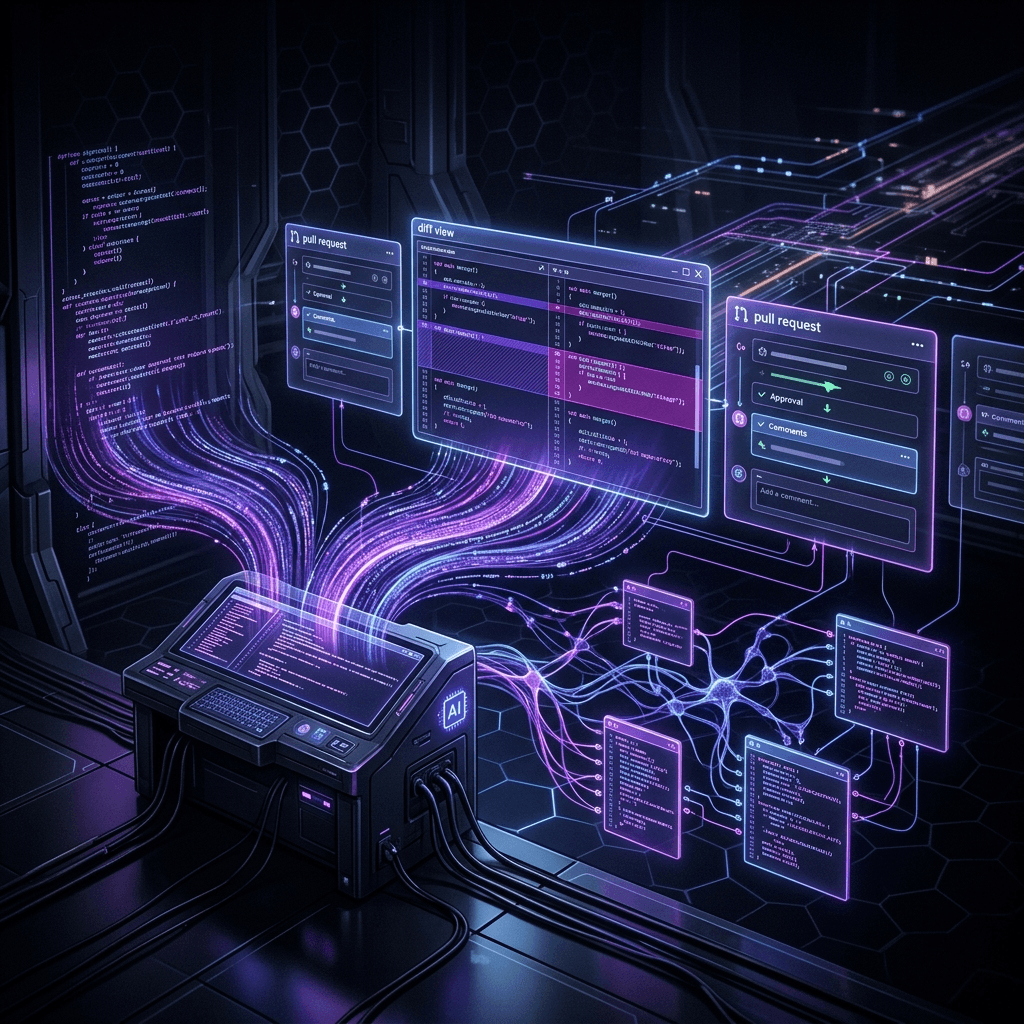
Claude Code Masterclass: Architecting Agentic Workflows, 1M Token Context, and The Death of Manual PR Reviews

Table of Contents
1. What is Claude Code? The Core Answer #
Claude Code is an elite, agentic AI coding assistant developed by Anthropic that natively integrates into your CLI, VS Code, and JetBrains IDEs.
Unlike legacy AI coding tools that only predict the next line of code, Claude Code operates as a fully autonomous development team within your local environment. In its 2026 iteration, powered by Claude Opus 4.6 and Sonnet 4.6, it intrinsically understands vast repositories up to a staggering 1M token context limit. It actively reads and edits files, traverses directories, runs terminal commands, debugs compilation errors, authors automated PRs (Pull Requests), and uses the Model Context Protocol (MCP) to communicate directly with external APIs, databases, and enterprise platforms like Slack and GitHub Actions.
The CLI That Thinks #
Previous AI models lived in a box. They could write a beautiful Python scraping script, but you had to run it. If it lacked a library, it failed. Claude Code changes this at the foundational level. It operates persistently in your terminal, executing its own bash commands, reading large multi-file directories at once, and running autonomous debugging loops without you typing line-by-line.
In Short: A Senior Engineer in Your Terminal #
It is a tireless, senior-level engineer living in your terminal. It does not just suggest code; it writes architectural code, tests it, detects container dependency failures, rewrites the deployment logic, pushes to a terminal, and verifies the commit—all with zero intervention from a human overseer.
2. The Broad Market Context: Why Claude Opus 4.6 is Crushing GPT-5.2 in 2026 #
If you have been following the AI space, you know that the benchmark wars have reached a fever pitch. But here is the secret: theoretical benchmarks do not pay the bills. Real-world shipping velocity does.
However, when theoretical dominance mirrors real-world utility, you have to pay attention.
Sweeping the Benchmarks #
In recent evaluations across industry-standard leaderboards like SWE-bench, Terminal-Bench 2.0, and the newly established GDPval-AA (Generalized Developer Productivity Valuation), Claude Opus 4.6—the brain behind the newest Claude Code—is systematically dismantling the competition.
- Terminal-Bench 2.0: Claude Code outmaneuvered Cursor and Devin by executing multi-step environment configurations and complex dependency resolutions with 32% fewer loop failures.
- SWE-Bench Pro: Opus 4.6 scored consistently around 55–80% depending on language and framework complexity, obliterating basic autocomplete AIs.
- Deep Context Navigation: Because of its ultra-reliable 1M token context window, Claude Code handles massive, monolithic codebases without the "amnesia" that plagues other LLMs. You can feed it entire API documentation suites, three years of commit history, and a complex GraphQL schema, and it will output perfectly compliant code.
The Enterprise Adoption Reality (2026 Stats) #
The numbers from the trenches reflect a massive operational transformation in how elite tech companies work.
- Anthropic recently reported 84% developer AI adoption inside organizations that rolled out Claude Code.
- An astonishing 41% of all commits in monitored enterprise branches are now entirely AI-assisted or AI-generated.
- PR Bottleneck Elimination: Using Claude Code's advanced integrations (connecting directly via MCP to Slack and GitHub Actions), automated code reviews are intercepting and resolving PRs instantly.
The Context Window Paradox #
Competitors largely operate in the 100K to 200K token range. When integrating complex custom architectures—like linking a raw LLM, a proprietary RAG database, and Twilio for an AI voice agent—200K tokens is not enough context. Claude's 1M context processes the entire ecosystem at once.
3. Inside the Machine: Latest Feature Releases and The Rise of Agent Teams #
Between February and April 2026, Anthropic released updates that morphed Claude Code from a powerful tool into an entire software organization. Let's break down the technical weaponry at your disposal.
Opus 4.6 and Sonnet 4.6: The Heavyweights #
The update to the Opus 4.6 and Sonnet 4.6 models brings adaptive thinking and staggering memory. You now have a 1M context token window and a massive 128k output threshold.
What this means for you: You no longer need to say, "Write this script in chunks." Claude Code can generate an entire, production-ready microservice—complete with tests, Dockerfiles, and CI/CD pipelines—in a singular, continuous output.
Agent Teams and /loop Architecture #
You are no longer bound by single-threaded tasks. Claude Code now supports Agent Teams. By using the new /loop command, you grant the AI bounded autonomy.
- The Workflow: You tell Claude Code: "Here is our backlog of 15 Jira tickets regarding UI bugs in our React app. Use /loop to fetch the ticket, find the relevant code, fix the bug, run the Jest tests, and if the tests pass, create a commit and push the PR. Do not stop until the queue is empty." Claude acts as a project manager, QA engineer, and UI developer simultaneously.
Adaptive Thinking and the /effort Control #
Not every task requires the maximum intellectual bandwidth of Opus 4.6. By using the /effort control flag, developers orchestrate cost and compute efficiently.
- /effort low: Rapid scaffolding, linting, and basic boilerplate generation.
- /effort medium: Standard zero-shot prompts, basic copywriting, or standard API payload transformations.
- /effort high: Architecting a bespoke real-time voice agent server traversing multiple WebSockets.
- /effort max: Massive codebase migrations, solving complex mathematical models, or evaluating extreme logic puzzles.
The $25/PR Automated Code Review Agent #
Perhaps the most incredible ROI feature released. For a compute cost of roughly $25 per PR, Claude Code's dedicated Code Review agent will rip through pull requests. It boasts an 84% bug detection rate, catching race conditions, memory leaks, and logic flaws that exhausted human reviewers miss on Friday afternoons. $25 to ensure the integrity of a $10M SaaS product? That is not a cost; that is an arbitrage.
Multi-Modal Commands: /voice, /remote, and Focus View #
- /voice: Dictate complex architecture logic straight into your IDE while you are pacing your office. Claude transcribes, interprets the structural intent, and scaffolds the code.
- /remote: Trigger and monitor heavy agentic builds running on dedicated cloud clusters straight from your local terminal.
- Dispatch and Persistent Threads: Anthropic introduced "Dispatch," an architecture that allows persistent threads. Previously, closing a session meant clearing the AI's short-term memory. Dispatch lets Claude Code "wake up" the next day, remember the exact debugging context from yesterday, and pick up right where it left off.
- Computer Use Preview: Enables the AI to control specific browser functions and GUI elements locally to run visual end-to-end tests—a massive leap for QA automation.
4. Claude Code Security: Bulletproofing Your AI Pipelines #
In February 2026, Anthropic launched Claude Code Security in preview. As code generation scaled, a terrifying new threat vector emerged: AI-enabled attacks and hallucinated vulnerabilities. Developers were blindly accepting AI code that contained massive security flaws.
Multi-Agent Review System #
Claude Code uses a multi-agent review system. When Opus generates code, a secondary, entirely separated security agent (usually running a fine-tuned Sonnet model) scans the generated block in real-time.
- Vulnerability Scanning: Proactively hunts for OWASP top 10 vulnerabilities before the code ever leaves your local terminal.
- Human-in-the-Loop Patches: For high-risk, core-auth functionalities, Claude Code pauses execution and forces a human review, providing a detailed reasoning path of why it flagged the code.
The March Source Code Leak: What We Learned #
Between March and April 2026, the tech community was rocked by an unprecedented incident: The Claude Code Source Code Leak. Due to a complex packaging error involving a bug in the automated Bun runtime compiler and a tragically missing .npmignore file, over 500,000+ lines of Anthropic's proprietary internal code were accidentally exposed to package registries.
The Good News: No customer code or proprietary data was leaked. The exposure was strictly Anthropic's internal architecture, prompt frameworks, tool-use logic, and sandbox environments. Anthropic's rapid response, paired with the April release of AWS Bedrock support, actually proved their robust enterprise-grade security protocols.
The "EvilTokens" Threat #
Because Claude Code has autonomous execution rights on your terminal, malicious actors theorized that by embedding "EvilTokens" (highly obfuscated prompt-injection strings) inside seemingly innocent open-source NPM packages or GitHub repositories, they could hijack a developer's Claude Code agent when it read those files.
How to defend yourself: Anthropic immediately patched runtime execution boundaries, but as a technical operator, you must ensure your Claude Code environment is rigorously sandboxed. Use strict permission flags and require explicit user approval for dangerous CLI executions (like rm, curl, or unverified npm scripts).
5. The CLAUDE.md File: Your Codebase's Operating System #
This is the most critical and underutilized step. Just as humans need Standard Operating Procedures (SOPs), Claude Code relies on a CLAUDE.md file placed in the root directory.
What is CLAUDE.md? #
This file acts as the system prompt for your codebase. When you issue a CLI command, Claude Code reads your prompt through the lens of the CLAUDE.md file, ensuring architectural consistency across the entire team.
Example CLAUDE.md Structure #
# Architecture Guidelines
- Stack: Next.js 15 (App Router), TailwindCSS, TypeScript, Supabase.
- All database queries MUST use the custom `/lib/db` fetch wrappers. Do NOT write direct Prisma queries in UI components.

# Build Commands
- Run tests: `npm run test:watch`
- Build standard: `npm run build`

# Operational Cadence
- Always run `npm run lint` before suggesting a Git Commit.
- Use `/effort high` when refactoring state management.
Why It Matters #
Claude Code automatically parses this file before every action, ensuring every line of code it writes adheres exactly to your company's proprietary standards. Without it, you are leaving code quality to chance.
6. Step-by-Step Implementation: Building an Agentic Work Environment #
If you want to start using Claude Code to scale your customized operational solutions, you need to set it up correctly. This is not just installing an app; it is architecting an environment.
Phase 1: Installation and Initialization #
- Terminal Integration: Claude Code runs natively via Node.js. Install it globally by running
npm install -g @anthropic-ai/claude-code. - API Key Authentication: Bind your terminal to your Anthropic Enterprise or Max account. Run
claude initand input your specific API keys. - Project Context Parsing: Navigate to your project directory. Run
claude map. The CLI will traverse the directory structure, caching the relationships between your dependencies, node modules, and core logic.
Phase 2: Advanced Slash Commands #
Stop treating generative AI as a chatbox. Treat it as a direct command operator.
- @code.md formatting: Use the
@symbol to bring specific documentation directly into the terminal context. If you are building a Meta Ads integration, type:claude "Build an automated daily ad spend report function using the guidelines in @docs/meta-api-rules.md" - The /loop and /schedule pipeline: Let's say you have a flaky script handling AI Voice Agent recordings. Run:
claude /loop "Run the test suite for the voice webhook. If it fails, read the stack trace, update the retry logic in the webhook controller, and test again. Do this until the test passes."Claude Code will spin autonomously in the terminal, fixing its own mistakes, executing tests, and returning a success message while you focus on high-level strategy.
Phase 3: Integrating the Model Context Protocol (MCP) #
MCP (Model Context Protocol) is the open standard that connects Claude to external datasets.
Want Claude Code to read your real-time production database logs, check Jira, and then write the bug fix?
- Start an MCP server locally that hooks into your tools (e.g., PostgreSQL, Jira API).
- Configure Claude Code to listen to these MCP tools.
- Now, you simply type: "Check the MCP integration for recent Jira tickets assigned to me. Find the code causing the bug, fix it, and update the Jira ticket when done."
7. Custom Automation Workflows: Turning Claude Code Into Your Entire DevOps Team #
Writing code is great. Building self-sustaining automation architectures is better. At williamspurlock.com, we bridge the gap between hardcode and practical operational automations.
Workflow 1: CI/CD Linked to Make.com Webhooks #
We automate the deployment and notification pipeline end to end.
- The Trigger: A developer uses Claude Code to finalize a branch. By typing
claude "Review my code, run tests, and open a GitHub PR with a summary", Claude generates the Pull Request. - Multi-Agent Review: Claude Code's GitHub integration automatically kicks in, doing a secondary code review and auto-merging the branch if it passes all security checks.
- The Make.com Webhook: Once merged, GitHub Actions blasts a JSON payload to a custom webhook sitting on Make.com.
- Operational Magic: Make.com receives the payload, parses the changelog created by Claude, formats a pristine, non-technical project update, sends it via Slack to the project manager, and emails the client letting them know their new AI feature is live.
Zero human intervention from the PR review to the client notification.
Workflow 2: Mobile Remote Control and Voice Scheduled Tasks #
Because of the recent Discord and Telegram Channel integrations, you no longer need to be sitting at a terminal to manage your infrastructure.
Use Case in Action: You are at dinner, and a client reports a critical server crash. You pull out your phone, open Telegram, and use Voice Mode: "Claude, check the server logs from the last 20 minutes for our Meta Ad API integration. Find the timeout error, draft the fix in the polling script, push it to staging, and run a test."
Claude takes the audio, transcribes it, connects to your remote environment, executes the exact scheduled sequence, uses its computer-use function to navigate the staging server, confirms the fix, and texts you back: "Fix deployed. Waiting for your approval to push to Prod."
That is not sci-fi. That is what you can build right now.
Workflow 3: AI Voice Agent Backend Built in Minutes #
Building outbound AI voice agents requires heavily nested logic trees—interruption handling, latency reduction, and dynamic API endpoints like booking a calendar slot mid-call.
Instead of our developers spending 10 hours wiring a webhook from Vapi or Retell AI into our custom CRM, we use Claude Code:
"Read the Retell AI payload structure from @docs/retell_payload.json. Generate an AWS Lambda function that parses the transcription, extracts the target's email using regex, and pushes a GraphQL mutation to update our client's CRM. Execute the build and deploy to AWS using our CLI credentials."
What took 10 hours now takes 18 minutes. The cognitive load on the team plummets. Capacity to take on new clients skyrockets.
8. Benchmarking the Beast: Claude Code vs. Cursor vs. Copilot #
The AI coding wars are brutal, but the data does not lie.
Claude Code vs. GitHub Copilot #
GitHub Copilot is predominantly a sophisticated autocomplete tool operating inside your IDE, offering suggestions as you type. Claude Code is an agentic CLI tool. It operates in your terminal, can execute its own bash commands, read large multi-file directories at once using Opus 4.6's 1M context token window, and run autonomous debugging loops without you typing line-by-line.
Claude Code vs. Cursor IDE #
Cursor is a phenomenal, AI-native development environment. It has elite codebase awareness and multi-file editing capabilities. But it is fundamentally reactive. You are driving the car; Cursor is the GPS. Claude Code is the driver.
Claude Code vs. Devin #
While Cursor acts primarily as an IDE with an advanced AI copilot, and Devin functions strictly as a standalone autonomous software engineer, Claude Code brilliantly bridges the gap. With its 2026 multi-agent capabilities and computer use, it acts autonomously like Devin, but integrates directly into your existing workflows and IDEs like Cursor, backed by the unmatched reasoning of the Sonnet 4.6 model.
The Token-Heavy Trade-off #
Let me be brutally honest: Claude Code is a heavy piece of machinery. Because it reads the whole codebase to ensure precision, it is incredibly token-heavy—often using up to 4x the tokens of older models. However, calculating the ROI of token costs versus a senior developer's hourly rate makes this a non-issue for aggressively scaling companies.
9. The Economics: Pricing, ROI, and Why You Need This Now #
Let's talk money, because operational efficiency ultimately comes down to margins.
The Pricing Breakdown #
- The Pro Plan ($20/month): Great for solo developers or boutique agency owners dabbling in automation. However, it comes with strict usage limits regarding the 1M token context windows. You will quickly hit hourly caps if you are doing massive legacy codebase refactoring.
- The Max / Enterprise Tier ($100–$200/month/seat): This is where serious players live. Dramatically expanded context limits, priority inference routing, and full fleet-management capabilities for CTOs watching over multi-agent reviews.
The Mathematical ROI #
Enterprise reviews with Claude Code run roughly $15 to $25 per deeply audited Pull Request.
If you hire a Senior Full-Stack Engineer, you are paying upwards of $150,000 to $200,000 per year. Fully burdened, that is roughly $100 per hour. When your Senior Engineer takes 90 minutes to deeply review a complex PR, trace the dependencies, and write out feedback, it costs you $150. And they are humans—they miss things.
Claude Code executes that identical process in 3 minutes. It holds massive architecture diagrams perfectly in its 1M context window, checking dependencies your human engineer did not even know existed. It detects 84% of critical issues. It costs $25.
You are achieving a 600% ROI on cost alone, let alone the velocity multiplier of shipping software 10x faster because PRs do not sit in a queue for three days waiting for human approval. By integrating the Enterprise Analytics API, CTOs can dynamically track exact ROI, seeing exactly how many hours Claude Code saved their teams per sprint.
10. Skills 2.0, Voice Control, and The Future of Agentic Development #
The 2026 update cycle did not just bring performance improvements—it brought entirely new paradigms for how developers interact with AI.
Skills 2.0 and Executable Workflows #
Anthropic unlocked executable workflows via Skills 2.0. This allows Claude Code to natively interact with external environments like Google Workspace and Office apps. Need the AI to read an API spec document provided by a client in a Google Doc and immediately start scaffolding the code? Skills 2.0 handles it.
Voice Control Integration #
With the introduction of Voice Control, developers and prompt architects can verbally command codebase refactors—bridging the gap between spoken logic and programmatic execution. You can now dictate complex architecture decisions while pacing your office, and Claude Code translates that intent directly into structured, tested code.
Auto-Mode for PR Fixes #
Instead of a human reviewing a GitHub pull request, identifying a syntax issue, making a comment, and waiting for the developer to fix it, Claude Code automatically flags, branches, fixes, and updates the PR autonomously. This is the end of the PR bottleneck.
The /schedule Command #
You can now command your CLI agent to execute specific repository checks at predefined intervals. Security sweeps every morning at 7 AM. Dependency audits every Friday. Test suite runs every time a new branch is created. All automated, all autonomous.
FAQ Section #
Q: What is Claude Code and how does it compare to Cursor or Devin? #
A: Claude Code is Anthropic's agentic coding platform. While Cursor acts primarily as an IDE with an advanced AI copilot, and Devin functions strictly as a standalone autonomous software engineer, Claude Code brilliantly bridges the gap. With its 2026 multi-agent capabilities and computer use, it acts autonomously like Devin, but integrates directly into your existing workflows and IDEs, backed by the unmatched reasoning of the Opus 4.6 model.
Q: Is Claude Code safe to use after the March 2026 source code leak? #
A: Yes. The March source code leak involved Anthropic's internal proprietary repositories regarding unreleased features like "Proactive Mode." No customer data, user inputs, enterprise codebases, or API keys were exposed. Anthropic's rapid response, paired with the April release of AWS Bedrock support, actually proved their robust enterprise-grade security protocols.
Q: How do I use Claude Code's computer use and screen navigation features? #
A: Computer Use is accessed via the Cowork integration alongside Claude Code. Once installed in your environment, you grant the agent specific permissions to control your local cursor or a virtualized container instance. By providing visual prompts (e.g., "Run this script and visually verify the dashboard updates without errors"), Claude automatically orchestrates a browser, clicks elements, and reads the screen pixels to inform its coding corrections.
Q: What does Claude Code cost for enterprise teams? #
A: Claude Code operates on usage-based metrics depending on the complexity of the tasks and context length. For highly complex, multi-agent enterprise Pull Request reviews, teams average $15 to $25 per PR. For seat-based access, the Max tier runs $100–$200/month/seat with dramatically expanded context limits and priority inference routing.
Q: What makes Claude Code different from GitHub Copilot? #
A: GitHub Copilot is predominantly a sophisticated autocomplete tool operating inside your IDE, offering suggestions as you type. Claude Code is an agentic CLI tool that operates in your terminal, executes its own bash commands, reads large multi-file directories using Opus 4.6's 1M context token window, and runs autonomous debugging loops without line-by-line prompting.
Q: How does Claude Code handle proprietary and sensitive data? #
A: Anthropic heavily emphasizes zero-retention policies for its enterprise tiers. Under Claude Code Security protocols, your proprietary codebase is processed in isolated endpoints and is never used to train Anthropic's foundational models. Furthermore, its built-in vulnerability scanner reviews generated code to ensure you are not integrating AI-hallucinated security flaws.
Q: Can non-developers use Claude Code? #
A: While Claude Code requires a basic understanding of the command line and terminal navigation, it significantly lowers the barrier to entry. If an operator understands the fundamental logic of systems (i.e., how APIs communicate), they can prompt Claude Code to generate, test, and deploy functional backend scripts with very little traditional programming knowledge.
Q: Does the 1M token limit actually make a difference? #
A: Absolutely. A standard application with React frontends, Node backends, and SQL schemas easily exceeds 150,000 tokens when bundled. Models limited to 200k tokens "forget" early parts of your code. The 1M token limit ensures Claude understands your complete software architecture natively before applying a single edit.
Q: What is CLAUDE.md and why is it critical? #
A: CLAUDE.md is a Markdown file placed in the root of your project directory that acts as the global system prompt and architectural rulebook for your local repository. Claude Code automatically parses this file before every action, ensuring every line of code it writes adheres exactly to your company's proprietary standards. Without it, you are leaving code quality to chance.
Q: How do the /loop and /schedule commands work? #
A: The /loop command instructs Claude Code to test a specific API endpoint or task repeatedly, debugging every failure autonomously until it passes the test suite. The /schedule command lets you set time-based triggers for repository checks—security sweeps, dependency audits, or test suite runs—all executed autonomously at predefined intervals.
Conclusion: Stop Bleeding Engineering Hours #
We are staring down a fundamental shift in business operations. Running manual operations—whether it is writing repetitive boilerplate code, manually reviewing pull requests, managing scattered Facebook ad sets, or dialing leads by hand—is a surefire way to kill your profitability. You are taxing your most valuable asset: human creativity.
Claude Code proves that complex implementations can now be handled by hyper-intelligent, agentic workflows. When you pair an agentic CLI tool with advanced business automation (Make, webhooks, specialized APIs), you transition from a linear growth model to an exponential one.
The AI development race is already won. The foundational tools are here, they are live, and they are generating massive revenue for the founders who are brave enough to restructure their companies around them.
You can continue doing things the hard way. You can keep writing massive checks to developers who spend half their time resolving Git errors and writing boilerplate tests. You can accept that shipping new internal automations takes four months.
Or, you can adapt.
If you are tired of theoretical AI noise and want real, heavy-duty custom AI and automation systems integrated into your business right now—if you want to implement autonomous workflows, sophisticated Meta Ad AI, and deep operational coding logic that scales up your agency—it is time to build.
Don't get left behind. Reach out and let's build your custom AI solution today at williamspurlock.com. Let's turn your bottlenecks into raw throughput.
Related Posts
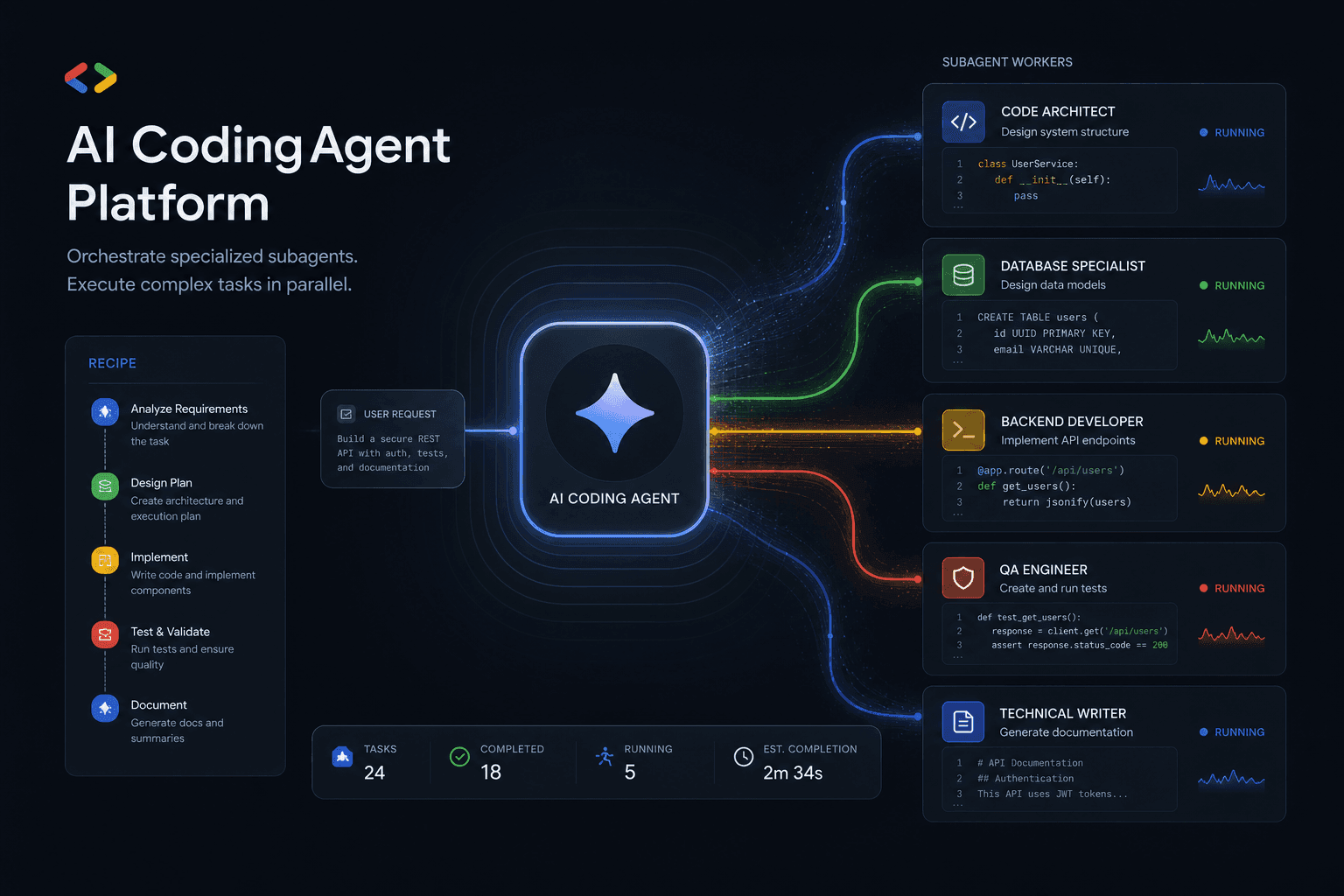
Antigravity 2.0 Subagent Recipes: How I Prompted Multi-Agent Workflows Day One
Five complete subagent recipes for Google Antigravity 2.0 that save 90+ minutes on Day One. From Friday audits to client onboarding, research briefs to migration assistants.

Google Antigravity Agents: The Complete Blueprint to Multi-Agent Orchestration and Enterprise Automation
The complete blueprint for deploying Google Antigravity multi-agent teams integrated with n8n. Build self-healing workflows, autonomous SEO pipelines, and lead gen systems that operate without human intervention.

Google Antigravity Skills: Mastering AI-Assisted IDEs and Agentic Orchestration
Master Google Antigravity Skills — the modular markdown-based system that turns AI agents into domain-specific experts. Learn to build, configure, and deploy custom skills for autonomous development.