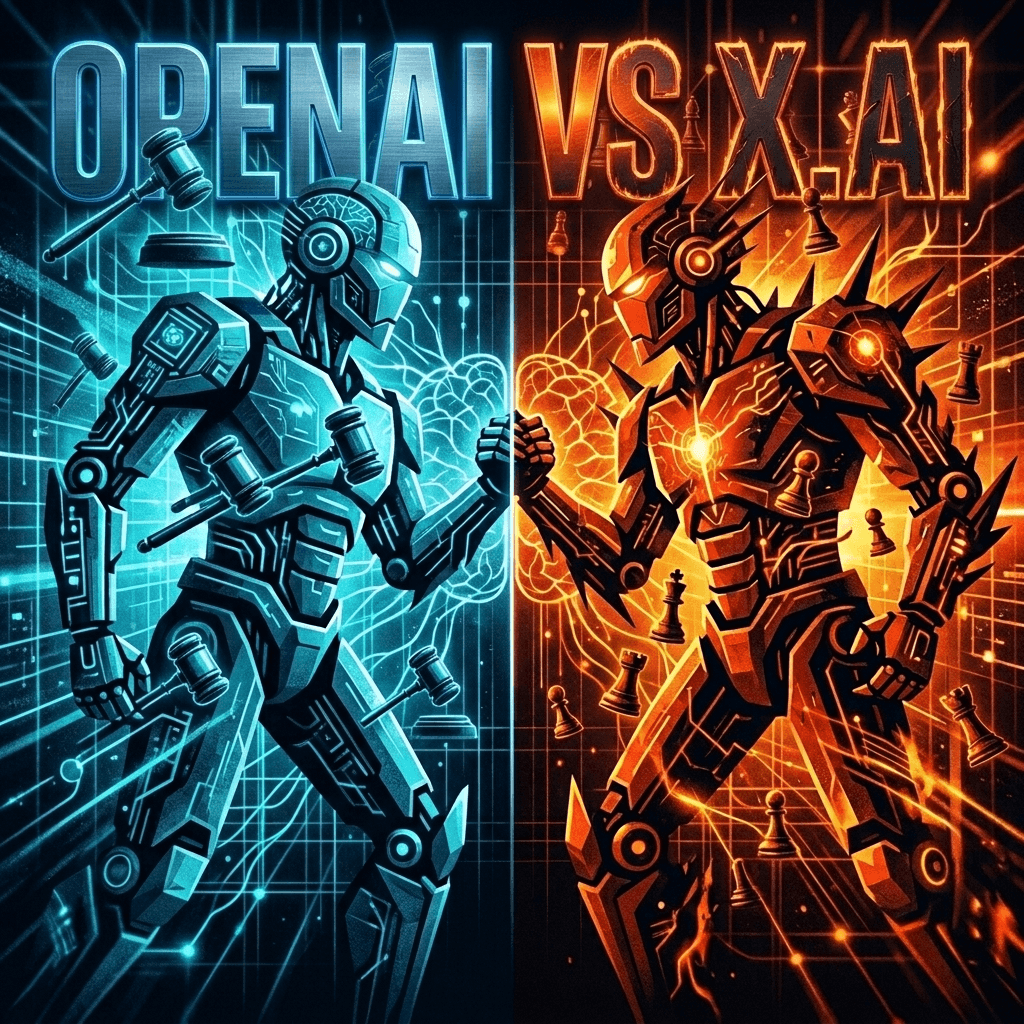
OpenAI vs. xAI: The Trillion-Dollar War for the Future of AGI
Table of Contents
OpenAI vs. xAI: The Trillion-Dollar War for the Future of AGI #
It began as a unified philanthropic mission to save humanity from the existential threat of rogue Artificial Intelligence. Today, it has mutated into the most vicious, high-stakes corporate blood feud in the history of Silicon Valley.
The rivalry between Elon Musk's xAI and Sam Altman's OpenAI is no longer just a competition for market share; it is an ideological holy war, a legal bloodbath, and a literal race to build a digital god. As of late April 2026, this conflict has culminated in a historic, multi-billion-dollar trial unfolding in a federal court in Oakland, California, alongside a geopolitical scramble for compute dominance.
This isn't just about who builds the best chatbot. This is about power, betrayal, the fundamental control of Artificial General Intelligence (AGI), and the dark, often dirty realities of the tech elite.
Table of Contents #
- 1. The Genesis: The Original "Founding Agreement"
- 2. The Schism: Musk's Ouster and the Profit Pivot
- 3. The Birth of xAI and the "Anti-Woke" Grok
- 4. The $150 Billion Lawsuit: "Stealing a Charity"
- 5. The November 2023 Board Coup and Ilya's Regret
- 6. The Restructuring: OpenAI's Public Benefit Corporation
- 7. The xAI Infrastructure Explosion: Project Colossus
- 8. The DOGE Conflict: Musk's Government Power Play
- 9. Data Privacy and the xAI Training Controversy
- 10. The Road Ahead: Potential Solutions and Endgame Scenarios
- FAQ Section
- Conclusion
1. The Genesis: The Original "Founding Agreement" #
To understand the venom of 2026, you have to look at the idealism of 2015. OpenAI was born out of a shared terror. Elon Musk, Sam Altman, Ilya Sutskever, Greg Brockman, and a handful of elite researchers formed the lab as a non-profit entity.
The Open Source Promise #
The core thesis was that advanced AI was too dangerous to be controlled by a single mega-corporation (at the time, Google/DeepMind). OpenAI was designed to act as a counterweight—a transparent, open-source laboratory dedicated to developing AGI for the explicit, uncompromised benefit of humanity. Musk was the primary early financier, injecting an estimated $38 million into the nascent project.
The Seed of Mistrust #
However, internal emails revealed during the 2026 lawsuit discovery process showed that the foundation was built on sand. As early as 2017, key founders like Sutskever expressed deep-rooted mistrust of Altman's motivations, fearing his inclination toward commercialization. Conversely, the board was equally terrified of Musk's desire for "absolute control," internally voicing fears that he wanted to create an "AGI dictatorship."
2. The Schism: Musk's Ouster and the Profit Pivot #
By 2018, the compute demands for training large neural networks had skyrocketed. The non-profit structure was starving the company of the capital required to compete with Google.
The Failed Tesla Merger #
Musk, realizing the financial reality, reportedly issued an ultimatum: hand over majority control, name him CEO, or merge OpenAI into Tesla so it could leverage the automaker's massive capital. Altman and the founders refused. Furious, Musk resigned from the board in February 2018, cutting off his funding and citing conflicts of interest with Tesla's autonomous driving AI.
The "Capped-Profit" Subsidiary #
Without Musk's checkbook, Altman executed a controversial pivot in 2019, creating a "capped-profit" subsidiary to raise billions. This allowed Microsoft to invest massively—eventually totaling over $13 billion. To Musk, this was the ultimate betrayal. The open-source, non-profit lab he funded had effectively become a closed-source, proprietary R&D arm for Microsoft. When ChatGPT launched in 2022, Musk openly branded the company "ClosedAI."
3. The Birth of xAI and the "Anti-Woke" Grok #
Musk's response to ChatGPT's dominance was swift and deeply personal. In July 2023, he announced the formation of xAI, explicitly positioning it as a direct adversary to OpenAI.
Recruiting the Resistance #
xAI aggressively poached top-tier engineering talent from OpenAI, DeepMind, and Tesla. Musk's stated mission for xAI was wildly ambitious: "to understand the true nature of the universe." However, the immediate commercial goal was to build a consumer-facing AI that lacked the safety rails and "woke mind virus" censorship he accused ChatGPT of possessing.
The Rise of Grok #
In November 2023, xAI launched Grok, integrating it directly into the X (formerly Twitter) platform. Grok was marketed as a rebellious, truth-seeking AI with real-time access to the global firehose of X data. While Grok initially lagged behind GPT-4 in benchmark capabilities, xAI's blistering pace of iteration—backed by Musk's unparalleled ability to deploy massive physical infrastructure—turned it into a legitimate existential threat to OpenAI's market dominance.
4. The $150 Billion Lawsuit: "Stealing a Charity" #
The corporate cold war turned radioactive in 2024 when Musk filed a massive lawsuit against OpenAI, Altman, and Brockman. After withdrawing the initial suit, he filed a revised, far more aggressive version that eventually went to trial in April 2026.
The Core Allegations #
Musk's legal team argued that Altman and Brockman orchestrated a premeditated scheme to "steal a charity." The lawsuit claims they used the non-profit mission to lure in early funding (like Musk's) and top talent, only to bait-and-switch the operation into a highly lucrative, closed-source Microsoft asset. Musk is demanding that the courts unwind the for-profit transition and direct an estimated $134 to $150 billion in damages back to the original non-profit entity.
The "Sour Grapes" Defense #
OpenAI's defense has been equally vicious. They characterize the lawsuit as a "harassment campaign" driven entirely by jealousy and competition. Their lawyers argue that Musk is simply experiencing "sour grapes" because his own attempts to take over the company failed. Furthermore, they assert that the transition to a for-profit structure was a necessary, pragmatic evolution to achieve AGI, a reality Musk himself acknowledged before his departure.
5. The November 2023 Board Coup and Ilya's Regret #
The inherent tension between OpenAI's non-profit board and its massive for-profit operations exploded in November 2023, exposing the structural fragility of Altman's empire.
The Five-Day Exile #
In a move that shocked the tech world, the OpenAI board summarily fired Sam Altman, claiming he was not "consistently candid." The coup was largely orchestrated by Ilya Sutskever, who had grown deeply alarmed by Altman's aggressive expansion and perceived lack of caution regarding AI safety. The fallout was catastrophic; over 700 employees threatened to resign en masse. Microsoft, blindsided and furious, offered to hire Altman and the entire OpenAI staff.
The Reversal #
Facing complete corporate collapse, the board capitulated. Altman returned triumphant five days later, and the board members who ousted him were purged. Sutskever, in a stunning reversal, expressed "deep regret" for his participation in the coup. He eventually left the company entirely in mid-2024. The incident permanently altered OpenAI, proving that capital and employee loyalty held more power than the non-profit board designed to keep the AI safe.
6. The Restructuring: OpenAI's Public Benefit Corporation #
The November 2023 crisis, combined with intense regulatory pressure and Musk's looming litigation, forced OpenAI into a radical structural evolution.
The October 2025 Transition #
By late 2025, OpenAI officially completed a massive corporate restructuring, converting its for-profit subsidiary into a Public Benefit Corporation (PBC). This legal structure requires the company to explicitly balance shareholder profit with its mission to benefit humanity.
The Illusion of Control? #
Crucially, the OpenAI Foundation (the non-profit) retained structural control, including the authority to appoint the PBC's board of directors. However, critics—including Musk—argue this is merely "legal theater." As OpenAI continues to raise capital at valuations surpassing $150 billion and pursues highly capable models like the o-series (o3, o4-mini) and GPT-5, the true ability of a non-profit board to throttle a trillion-dollar commercial juggernaut remains highly suspect.
7. The xAI Infrastructure Explosion: Project Colossus #
While the lawyers fought in California, the real war was being waged in the data centers. The only currency that matters in the race to AGI is compute, and by 2026, xAI had executed an infrastructure expansion that terrified OpenAI's executives.
The Gigafactory of Compute #
In Memphis, Tennessee, xAI constructed "Colossus"—a massive supercomputer cluster that went from an empty factory to a functioning 100,000-GPU array in just 122 days. By early 2026, backed by a massive $20 billion Series E funding round that pushed xAI's valuation past $230 billion, Musk claimed they had acquired over one million H100 GPU equivalents.
The Brute Force Strategy #
xAI's strategy relies on brute force scale and blistering speed. By deploying immense fleets of NVIDIA's latest silicon, Musk intends to overwhelm OpenAI's algorithmic lead with sheer computational mass. This arms race has forced OpenAI to deepen its reliance on Microsoft's Azure infrastructure and continually seek fresh capital, locking both companies into an incredibly expensive war of attrition.
8. The DOGE Conflict: Musk's Government Power Play #
The rivalry took on a deeply political dimension when Musk accepted a role as a "special government employee" to lead the Department of Government Efficiency (DOGE).
The U.S. Government Contract Controversy #
In 2025, the Department of Defense awarded contracts ceilinged at $200 million to several AI companies, prominently including xAI for its "Grok for Government" program. Simultaneously, xAI secured agreements with the General Services Administration (GSA).
Conflict of Interest Allegations #
Critics and ethics watchdogs exploded, pointing out a massive conflict of interest. Musk was advising the government on federal spending and regulations while simultaneously securing massive federal contracts for xAI. Furthermore, agencies targeted by DOGE for cuts—like the SEC, FAA, and NHTSA—were the very agencies investigating Musk's other companies (Tesla, SpaceX). To OpenAI and its supporters, this signaled that Musk was willing to leverage the entire apparatus of the U.S. government to gain an edge in the AI race.
9. Data Privacy and the xAI Training Controversy #
As xAI scaled, it hit the same wall OpenAI had encountered years prior: the desperate need for high-quality training data.
The "Default Opt-In" Scandal #
To train Grok, xAI utilized the massive data firehose of X (Twitter). In 2024, X stealthily changed its settings to default opt-in all user posts, interactions, and Grok queries for AI training. Privacy advocates were outraged, pointing out the difficulty of finding the opt-out mechanism.
The Regulatory Crackdown #
The European Union's data protection agencies aggressively targeted this practice, forcing X to temporarily suspend EU data usage and create a restricted "Grok-EU" variant. Meanwhile, in the U.S., California implemented the AB 2013 transparency law in 2026, forcing AI developers to disclose their training datasets. In a highly ironic twist for the "open-source" champion, Musk's xAI sued to block the law, arguing that Grok's training data constituted "protected trade secrets."
10. The Road Ahead: Potential Solutions and Endgame Scenarios #
As of mid-2026, the $150 billion trial is underway, xAI is valued at nearly a quarter-trillion dollars, and OpenAI's GPT-5 class models are demonstrating proto-AGI reasoning capabilities. How does this end?
Scenario 1: The Regulatory Hammer #
The most likely intervention won't come from a judge, but from the federal government. As both companies approach AGI, the Department of Defense and the Department of Energy may simply nationalize the underlying infrastructure or enforce draconian safety export controls, neutralizing the corporate rivalry entirely.
Scenario 2: The $97 Billion Stunt and Future Buyouts #
In early 2025, Musk made an unsolicited $97.4 billion bid to acquire OpenAI's non-profit arm to "restore its mission." Altman rejected it sarcastically, offering to buy Twitter for $9.7 billion instead. While the bid was largely performant, it highlights a potential future: one of these companies may simply bleed the other dry. If OpenAI's cash burn outpaces Microsoft's patience, or if xAI fails to monetize Grok effectively, consolidation (or total collapse) is inevitable.
Scenario 3: The Race to the Singularity #
The darkest, yet most realistic outcome is that the intense mutual hatred fuels a reckless race to the finish line. Driven by the fear that the other guy will win, both Altman and Musk may continually relax safety constraints in favor of capability, sprinting blindly toward an AGI that neither truly controls.
FAQ Section #
Q: Why did Elon Musk sue OpenAI? #
A: Musk alleges that Sam Altman and the OpenAI leadership betrayed the company's "founding agreement" to act as an open-source non-profit for the benefit of humanity. He claims they illegally transformed it into a closed-source, profit-driven subsidiary serving Microsoft's commercial interests, and he is seeking up to $150 billion in damages.
Q: What is xAI's valuation as of 2026? #
A: Following a massive $20 billion Series E funding round in early 2026, xAI's valuation soared to an estimated $230 billion, fueled largely by the massive computational infrastructure they built, including the Colossus supercomputer in Memphis.
Q: What is the "DOGE" conflict involving Elon Musk? #
A: Musk was appointed to lead the Department of Government Efficiency (DOGE) as a "special government employee." Critics allege a massive conflict of interest, as Musk advises on government spending and regulations while simultaneously his company, xAI, secures massive U.S. Defense Department AI contracts.
Q: Why did the OpenAI board fire Sam Altman in November 2023? #
A: The non-profit board, led at the time by Ilya Sutskever, fired Altman claiming he was not "consistently candid." Deeper reports indicate the firing was a "coup" driven by fears over Altman's aggressive commercial expansion and a perceived lack of caution regarding the safety of powerful AI models.
Q: Did Elon Musk try to buy OpenAI? #
A: Yes. In February 2025, Musk made an unsolicited $97.4 billion bid to acquire OpenAI's non-profit arm. Sam Altman publicly rejected the offer, sarcastically proposing to buy Twitter instead, further escalating the personal feud between the two billionaires.
Q: What is the controversy surrounding Grok's training data? #
A: In 2024, X (Twitter) changed user settings to automatically opt-in all public posts and interactions to train xAI's Grok model. This sparked massive privacy concerns and lawsuits from European regulators regarding a lack of transparency and digital consent.
Q: How did OpenAI restructure in 2025? #
A: To satisfy investors and regulatory pressure, OpenAI converted its for-profit subsidiary into a Public Benefit Corporation (PBC) in October 2025. While the non-profit OpenAI Foundation technically retains board control, critics argue the massive influx of capital has made the commercial side practically autonomous.
Q: Who is winning the AI race, OpenAI or xAI? #
A: It is a fluid arms race. OpenAI currently holds the lead in algorithmic reasoning with models like GPT-5 and o3-pro. However, xAI is rapidly closing the gap by deploying overwhelming computational scale, boasting millions of GPU equivalents in its Colossus data centers.
Q: What is the risk of the OpenAI vs. xAI rivalry? #
A: The primary risk is a "race to the bottom" regarding AI safety. As both companies fear losing the race to Artificial General Intelligence (AGI), they are financially and culturally incentivized to deploy increasingly powerful, autonomous models with potentially insufficient safety testing.
Q: What does AGI stand for and why does it matter? #
A: AGI stands for Artificial General Intelligence, an AI system that matches or surpasses human capabilities across all cognitive tasks. Control over AGI is considered the ultimate technological prize, potentially offering unlimited economic power and societal influence.
Conclusion #
The conflict between Elon Musk and Sam Altman is the defining corporate drama of the 21st century. What started as a philosophical disagreement over the safety of artificial intelligence has degenerated into a brutal, trillion-dollar war of attrition. Between the $150 billion lawsuits, the massive government contracts, and the unprecedented accumulation of computational power, the stakes have never been higher. As xAI and OpenAI relentlessly push their models toward AGI, the world watches—hoping that this vicious rivalry drives innovation, rather than pushing humanity toward an unsafe technological singularity.
Related Posts

How to Stop Client-Facing AI Agents From Hallucinating
Client-facing AI agents hallucinate when they answer without grounding. Here's the layered guardrail stack I use to keep agents accurate and on-script.

AI Sales Systems vs Traditional CRM Automation
Traditional CRM automation fires rules; AI sales systems reason about each lead. Here's how they differ, where each wins, and how to combine them.
The Manual Workflows With the Highest ROI When Replaced by AI Agents
Not every task is worth automating. Here are the manual workflows with the highest ROI when you replace them with AI agents, ranked by payback speed.