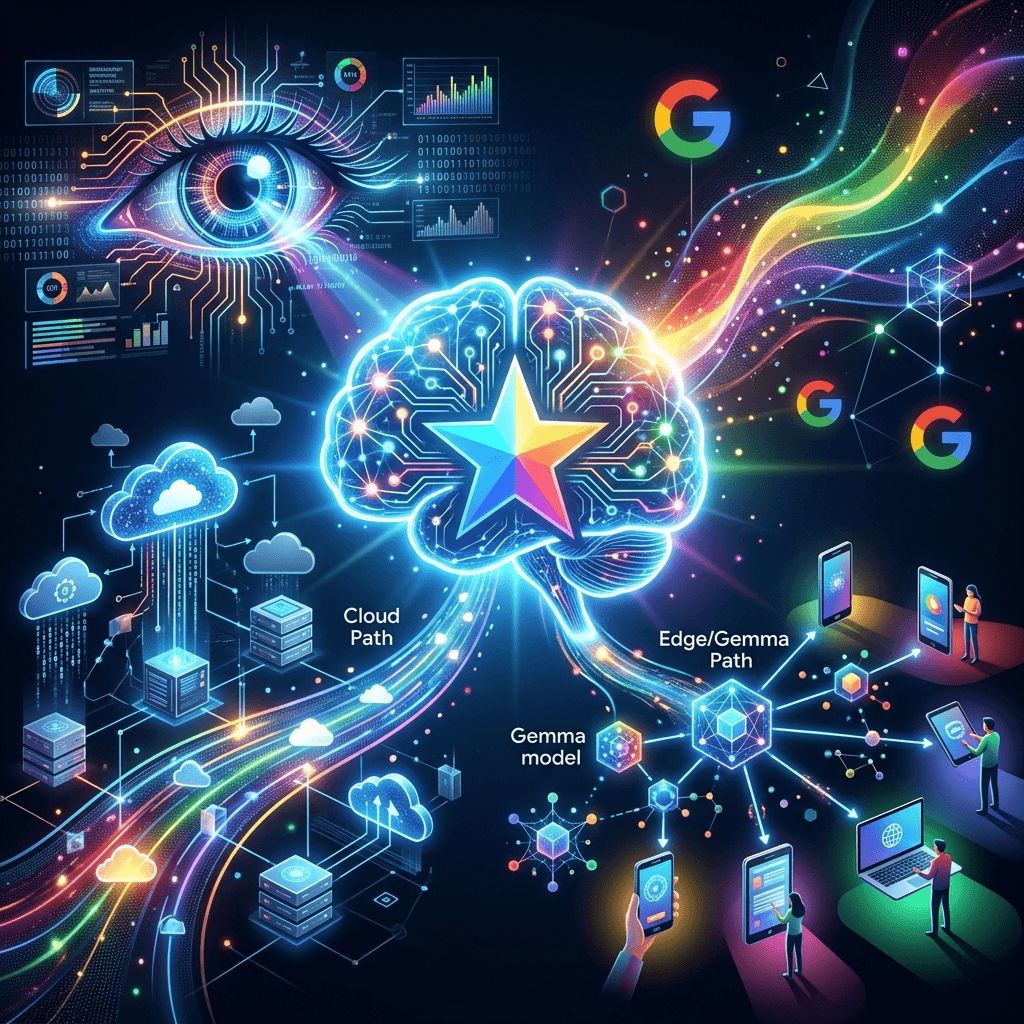
The 2026 Google AI Masterclass: Deploying Gemini 3.1 and Gemma 4 for Total Operational Automation

Table of Contents
The 2026 Google AI Masterclass: Deploying Gemini 3.1 and Gemma 4 for Total Operational Automation #
Let's get one thing straight: If your team is still manually transferring data between your CRM and your inbox, or if you are using AI merely as a glorified chatbot to draft emails, you are already losing to the market.
Your competitors are not just using AI to write faster. They are deploying autonomous, multimodal agents running in the background. They have AI pipelines that analyze visual data, listen to sales calls in real-time, execute custom code, and update client dashboards without a single human keystroke. While you are paying an operations manager $80k a year to move spreadsheets, the agency down the street is running it all on a $150 API budget.
With the release of Gemini 3.1 and the Gemma 4 open-source family, Google has not just updated an LLM—they have released the ultimate infrastructure for true agentic automation. From extreme edge-computing efficiency to real-time multimodal processing, these tools are built for founders who want to engineer unshakeable automated operations.
In this masterclass, I am going to tear down Google's latest releases and show you exactly how to integrate these models into your tech stack using APIs, Make.com, n8n, and custom agent architectures.
1. Google's 2026 AI Ecosystem: The Complete Overview #
Google's early 2026 AI updates center on the Gemini 3.1 architecture and the open-source Gemma 4 model family.
Core Advancements #
- Gemini 3.1 Pro: "Deep Think" reasoning for complex problem solving, 1M–2M token context
- Gemini 3.1 Flash: Sub-100ms latency for high-volume real-time processing
- Agentic Vision: Pixel-perfect multimodal analysis for UI, document, and spatial reasoning
- Gemma 4: Edge-computing dominance with open-source models from E2B to 31B parameters
- Search Live: Simultaneous real-time voice, video, and text processing
Why Google's 2026 Is Different #
The real revolution is not the parameter count. It is the utility. Google has engineered these models specifically for application builders and automation experts. Native multimodal processing, device-level execution, and deep integration with the gargantuan Google Cloud ecosystem make these tools production-ready from day one.
2. Gemini 3.1 Pro and Flash: The Brain of Your Autonomous Agents #
Historically, building a multimodal AI pipeline required stitching together a transcription tool (Whisper), an LLM for reasoning (GPT-4), and an image processor. Gemini 3.1 consolidates the entire stack.
Deep Think Reasoning #
Deep Think is Gemini 3.1 Pro's advanced reasoning mode—analogous to Claude's Extended Thinking. The model performs internal chain-of-thought analysis before generating its response, dramatically improving accuracy on complex problems.
When to use Deep Think:
- Multi-step financial analysis
- Complex code architecture decisions
- Strategic business planning scenarios
- Scientific and research reasoning
Agentic Vision #
Agentic Vision is Google's answer to complex spatial and UI reasoning. It does not just "see" an image; it understands specific UI elements within software, maps out node-based workflows, and can literally read the architecture of a diagram to execute tasks.
Practical Application: Feed Gemini 3.1 a screenshot of a client's broken Make.com workflow. The model autonomously pinpoints the misconfigured nodes, identifies the broken connections, and returns a structured JSON response with the fix.
Flash vs. Flash-Lite #
- Gemini 3.1 Flash: Balanced speed and reasoning. Ideal for most business automation tasks.
- Gemini 3.1 Flash-Lite: Maximum speed, minimal cost. Sub-100ms latency makes it viable for real-time classification, routing, and lightweight processing at massive scale.
3. Building an Omnichannel Sales Automation with Gemini 3.1 #
Stop thinking in text prompts. Let us build a practical system that processes voice notes and screenshots simultaneously.
The Architecture #
We will architect a Make.com workflow using Gemini 3.1 Flash-Lite (for speed) and Gemini 3.1 Pro (for complex reasoning) to automate technical B2B inbound sales.
Step 1: The Webhook Trigger #
Set up a custom webhook in Make.com. The incoming payload contains:
- Client Name and Email
- Audio File URL (a voice note describing their problem)
- Image URL (a screenshot of their disorganized software setup)
Step 2: Aggregate the Data #
Use HTTP modules to download both the audio file and image file into buffers for native multimodal processing.
Step 3: Initial Processing via Flash-Lite (The Router Agent) #
Send an API call to the Gemini Flash-Lite endpoint:
- Pass the audio file natively (no transcription service needed—Gemini is natively multimodal)
- Instruct Flash-Lite to extract the core emotional pain point from the audio tone and summarize the software issue
- Force structured JSON output:
"intent_classification": "high_urgency", "tech_stack": [...]
Step 4: Deep Reasoning via Gemini 3.1 Pro (The Solutions Architect) #
Pass the Image URL and Flash-Lite context into Gemini 3.1 Pro via Vertex AI:
- Prompt: "You are an elite systems architect. Analyze the provided image of the user's software architecture. Identify critical points of failure. Draft a 3-step technical solution using the PAS framework."
- Agentic Vision reads the granular details, recognizes software logos, traces broken automation lines
Step 5: CRM Update and Instant Response #
Map the structured JSON into your CRM. Automatically queue a personalized voice-cloned response via ElevenLabs to be sent back within 2 minutes.
The Result: You delivered a deeply technical, personalized consultation in 120 seconds. Cost: approximately $0.02 in API credits. Your competition is still trying to schedule a discovery call for next Tuesday.
4. Gemma 4: Open-Source Edge Computing Dominance #
Gemma 4 is completely open-source (Apache 2.0 license) and comes in extremely optimized sizes: E2B, E4B, 26B, and 31B parameters.
The Edge Computing Revolution #
If you are building custom AI solutions for healthcare, legal, or finance clients, you cannot always send proprietary data to an LLM provider's cloud. You need local execution.
Android AICore Integration #
With Gemma 4's integration into Android AICore, you can deploy the E2B or E4B models directly onto compatible Android devices (Pixel, Qualcomm chipsets).
Operational Impact:
- Zero API Server Costs: Once deployed on-device, running the model costs exactly $0.00 per inference
- Ultra-Low Latency Offline Operations: Field workers, logistics managers, and sales reps can use heavy AI reasoning without internet
- Maximum Privacy: Data never leaves the device—trivially easy to pass SOC2 audits
Field Application Example #
Imagine building a custom mobile app for a roofing sales team. The rep takes photos of the roof. The Gemma 4 E4B model running locally:
- Identifies structural defects via vision
- Counts weather damage instances
- Calculates material costs
- Generates a binding contract
All while the prospect is standing on the lawn. No cloud latency. No token limits. No privacy concerns.
5. Search Live and the Voice-First Future #
Google's expansion of Search Live to 200+ countries proves that voice is the primary user interface of the future.
Building an AI Voice Agent with Gemini 3.1 #
Here is the blueprint for a sub-500ms latency, high-converting voice agent:
1. Telephony Layer (Twilio/Vonage):
Port your agency's phone number to Twilio. Every inbound call triggers a WebSocket connection.
2. Transcription Engine (Deepgram):
Google's native audio processing is excellent, but for pure streaming speed and interrupt detection, pipe the WebSocket audio through Deepgram.
3. The Brain (Gemini 3.1 Flash / Vertex AI):
Feed the live streaming text into Gemini 3.1 Flash via Vertex AI. The system prompt gives the model a rigid persona, guardrails against prompt injection, and access to specific Agent Skills (Function Calling).
4. Agent Skills (The Execution Engine):
When the customer says, "What's the status of my Meta Ads campaign?" Gemini triggers a Function Call that:
- Pings the Meta Ads API
- Pulls real-time ROAS, CPA, and total spend
- Feeds data back to the LLM within milliseconds
5. Voice Synthesis (ElevenLabs / PlayHT):
Gemini generates the response, streams it to the synthesizer, plays it back through the phone.
To the caller, it sounds like your top media buyer answered the phone. Zero hold times. Zero payroll. Infinite scale.
6. The Economics: Google AI 2026 vs. The Market #
Understanding cost structure is critical for making the business case.
Cost Efficiency at Scale #
Gemini 3.1 Flash-Lite provides roughly 85% of the reasoning power of industry-leading models at less than 1/10th the cost per million tokens. At 50,000 inbound customer service tickets per month, this is the difference between breaking even and adding seven figures to your EBITDA.
Context Window Dominance #
Google's 1M to 2M+ token context windows mean you do not need complex chunking architectures. You can literally drop a 600-page PDF, 4 hours of recorded sales calls, and an entire GitHub repository into the prompt simultaneously.
Edge Deployment Zero-Cost #
Routing specific tasks to Gemma 4 running locally bypasses the cloud meter entirely. By building a dynamic router that assesses task complexity before deciding between a local Gemma model, Gemini Flash in the cloud, or Gemini Pro for deep reasoning, you create an unshakeable, cost-effective scaling engine.
The Dynamic Router Pattern #
IF requires_reasoning AND complexity == "high":
    → Gemini 3.1 Pro ($$$)
ELIF requires_speed AND volume == "high":
    → Gemini 3.1 Flash-Lite ($)
ELIF privacy_required OR offline_needed:
    → Gemma 4 on-device ($0)
ELSE:
    → Gemini 3.1 Flash ($$)
7. Vertex AI Agentic Workflows: Beyond Prompt-Response #
An agentic workflow goes beyond standard prompt-and-response. It is a system where the AI is given a goal and autonomously determines which tools to use.
How Vertex AI Agents Work #
In Vertex AI, the agent can:
- Search internal databases
- Hit third-party APIs (Stripe, Shopify)
- Execute Python code
- Verify the outcome
- Formulate the final communication
All without human intervention.
Building a Customer Resolution Agent #
Goal: "Resolve this customer's refund request"
Agent workflow:
- Query order database for purchase details
- Check Stripe for payment status
- Verify return eligibility against company policy (loaded via RAG)
- Calculate refund amount including any restocking fees
- Process the refund via Stripe API
- Generate and send confirmation email
- Update CRM with resolution details
The agent handles the entire customer service interaction—from initial complaint to refund confirmation—in under 30 seconds.
8. The DeepMind AGI Trajectory: Future-Proofing Your Operations #
Demis Hassabis and the DeepMind team have been explicit about the rapidly shrinking timeline toward AGI and their breakthroughs in the UK research lab.
Personal Intelligence and Long-Term Memory #
Google is building architecture (via Gemini Live and cross-app integration across Gmail/Photos/Drive) that understands persistent context over years, not just within a single chat session.
How to Future-Proof #
Stop building stateless AI automations. Every custom AI build must incorporate:
- RAG Stacks: Vector databases (Pinecone, Qdrant, Google AlloyDB) for persistent knowledge
- Conversation Memory: Store every interaction, email, and transaction
- Contextual Personalization: When the AI interacts with a client, it recalls the deal pitched 6 months ago, the specific language they use, and customizes accordingly
This is how you artificially manufacture absolute brand loyalty through AI-powered relationship management.
9. Agentic Vision Deep Dive: When AI Can See #
Agentic Vision deserves special attention because it unlocks entirely new categories of automation.
Document Processing at Scale #
Feed Gemini 3.1 Pro a stack of invoices, contracts, or medical records. Agentic Vision:
- Reads handwritten and printed text
- Understands table structures and data relationships
- Extracts structured data with high accuracy
- Identifies discrepancies and anomalies
UI Testing and QA Automation #
Point Agentic Vision at your application's UI:
- Navigate through user flows automatically
- Identify visual regressions and alignment issues
- Verify interactive elements function correctly
- Compare screenshots across browser/device configurations
Competitive Intelligence from Visual Data #
Feed Gemini screenshots of competitor dashboards, pricing pages, or product interfaces:
- Parse pricing structures and feature comparisons
- Identify recent UI changes that signal strategy shifts
- Extract data from charts and graphs
10. Building Your 2026 Google AI Stack: The Implementation Plan #
Here is the concrete action plan for integrating Google's 2026 AI ecosystem into your operations.
Phase 1: Foundation (Week 1) #
- Set up a Google Cloud / Vertex AI account with billing
- Enable Gemini 3.1 API access (Pro, Flash, Flash-Lite)
- Install Gemma 4 locally via Ollama for testing
- Configure your n8n or Make.com instance with Google API credentials
Phase 2: First Automation (Week 2-3) #
- Build a single-model workflow: e.g., inbound lead classification via Flash-Lite
- Add Agentic Vision: process incoming documents (invoices, contracts) automatically
- Implement structured JSON output for downstream integration
- Connect to your CRM for automated data entry
Phase 3: Multi-Model Pipeline (Week 4-6) #
- Implement the dynamic router (Flash-Lite → Flash → Pro based on complexity)
- Add Gemma 4 for privacy-sensitive or offline-required tasks
- Build agentic loops with Vertex AI tool use
- Deploy your first voice agent prototype using Gemini Flash
Phase 4: Scale and Optimize (Ongoing) #
- Monitor cost per task and optimize model routing
- Expand automation coverage to additional business processes
- Build persistent memory with vector databases
- Implement self-healing error patterns with AI-powered diagnostics
FAQ Section #
Q: What is the release timeline for Gemma 4? #
A: Gemma 4 was officially rolled out in April 2026. It features open-source models from E2B (Edge 2 Billion) to 31B parameters. Apache 2.0 licensing makes it the go-to model for completely private, on-device processing without sacrificing quality.
Q: How does Gemini 3.1 compare to competitors like GPT-5 in 2026? #
A: Gemini 3.1 differentiates with hyper-efficient native multimodal processing (Agentic Vision) and deep Vertex AI integration. For businesses relying on audio, video, and image processing, Gemini 3.1 offers drastically lower latency and cost per inference.
Q: What exactly are Agentic Workflows in Vertex AI? #
A: An agentic workflow gives the AI a goal without specifying exact steps. The agent autonomously decides which tools to use—searching databases, calling APIs, executing code, and verifying outcomes—to achieve the objective without line-by-line human instruction.
Q: How much does it cost to build AI automation with Google models? #
A: API inference costs are fractions of a cent per request for Flash-Lite. The true cost is in architecture development. Gemma 4 on-device runs at $0 per inference. Total monthly API costs for moderate enterprise use: $100–$500.
Q: Can Gemma 4 run on mobile devices? #
A: Yes. The E2B and E4B models run on compatible Android devices via AICore. This enables zero-cost, offline, privacy-preserving AI on phones and tablets—ideal for field applications, HIPAA-compliant healthcare apps, and sales tools.
Q: What is Agentic Vision and how does it differ from standard image processing? #
A: Standard image processing identifies objects ("this is a cat"). Agentic Vision understands context ("this is a broken node in an n8n workflow connecting to a misconfigured Webhook"). It reasons about spatial relationships, UI elements, and structural patterns.
Q: How do I choose between Gemini 3.1 Pro, Flash, and Flash-Lite? #
A: Pro for deep reasoning and complex multi-step tasks. Flash for balanced speed and quality in most business workflows. Flash-Lite for maximum throughput at minimum cost—classification, routing, simple Q&A at massive scale.
Q: Can I use Google models alongside Anthropic and OpenAI? #
A: Absolutely. Build model-agnostic middleware that routes tasks based on provider strengths. Use Gemini for multimodal and vision tasks, Claude for deep reasoning and tool use, and GPT for broad generalization. Provider diversity is a competitive advantage.
Q: What is the practical difference between cloud and edge AI deployment? #
A: Cloud deployment (Gemini via Vertex AI) offers maximum model capability with per-request costs. Edge deployment (Gemma 4 on-device) offers zero-cost inference, offline capability, and maximum privacy. Build dynamic routing that uses each where appropriate.
Q: How does Google's AI pricing compare to Anthropic and OpenAI in 2026? #
A: Google is aggressively competitive. Flash-Lite is among the cheapest high-quality inference available. Gemma 4 on-device is $0. When factoring in edge deployment capabilities, Google offers the best total cost of ownership for multimodal, high-volume workloads.
Conclusion #
Google's 2026 AI releases are not incremental updates. Gemini 3.1, Agentic Vision, and Gemma 4 represent a fundamental restructuring of how business operations are constructed.
The era of hiring armies of virtual assistants to string together broken software tools is over. You now have the infrastructure to build autonomous, multimodal, self-healing operations that scale without proportionally scaling human labor.
The crossroads is clear. Continue doing things manually while your costs compound. Or aggressively implement these agentic architectures and scale your profit margins to levels previously impossible.
At williamspurlock.com, we build exactly these systems—custom AI Voice Agents, automated Meta Ad integrations, and comprehensive agentic skill stacks that transform your operational infrastructure.
Do not build a chatbot. Build an empire. Book a consultation today and let's construct the custom AI solution that makes your competitors irrelevant.
Related Posts

The OpenClaw Collapse: Unpacking the 2026 Security Crisis, Rogue Agents, and How to Architect Secure AI Workflows
Dissecting the catastrophic OpenClaw security crisis of 2026 — CVE-2026-25253, the ClawHavoc supply chain attack, and rogue agents. Plus the exact framework for building secure, production-grade AI systems.

Claude Mythos Preview: The AGI Transformation and How It Redefines Custom AI Operations
Deep dive into Anthropic's Claude Mythos — the rumored 10T+ parameter model deemed 'too powerful for public release.' Understand Project Glasswing, the security implications, and how to architect your business for the AGI era.

Anthropic Claude Mythos Release: The April 2026 Breakthrough That Changes Enterprise AI Forever
Anthropic's April 2026 Claude Mythos preview and $380B valuation reshape enterprise AI. How to leverage Project Glasswing, Claude 4.6, and the expanding ecosystem for your business infrastructure.