The State of Open-Weights AI: Why Mistral 7B/8x7B Ruled the World (For Now)

Table of Contents
The Open-Weights Landscape in Early April 2024 #
The open-weights ecosystem in early April 2024 was dominated by a clear hierarchy: Mistral 7B for efficiency-conscious deployments, Mixtral 8x7B for performance that rivaled GPT-3.5, and Llama 2 70B holding ground for maximum capability at the cost of compute. This was the calm before the storm—developers knew Meta's Llama 3 was imminent, but the existing Mistral models had already proven that open weights could deliver production-grade results without API dependency.
The Post-Llama 2, Pre-Llama 3 Window #
The six-month gap between Llama 2's release (July 2023) and Llama 3's anticipated launch (April 2024) created a unique adoption window. Mistral AI—a Paris-based startup founded by former Meta and Google DeepMind researchers—had capitalized on this interim period by releasing models that outperformed Meta's offerings at every parameter count. By April 3, 2024, the landscape looked like this:
| Model | Release Date | Parameters | Apache 2.0 | Context Window | Key Advantage |
|---|---|---|---|---|---|
| Mistral 7B | Sept 2023 | 7.3B | Yes | 8K | Efficiency leader |
| Mixtral 8x7B | Dec 2023 | 46.7B (12.9B active) | Yes | 32K | GPT-3.5 competitor |
| Llama 2 70B | July 2023 | 70B | Yes | 4K | Raw capability |
| Llama 2 13B | July 2023 | 13B | Yes | 4K | Balanced option |
This window mattered because it gave teams time to validate open-weights deployments in production before the next major shift. Companies that had been hesitating on open weights due to quality concerns now had irrefutable proof that self-hosted models could match closed-source alternatives for most tasks.
Why Developers Were Switching to Self-Hosted Models #
Three primary drivers pushed developers away from OpenAI and Anthropic APIs toward Mistral and other open-weights alternatives:
1. Cost Economics at Scale
GPT-4 pricing in April 2024 sat at $60 per million input tokens and $120 per million output tokens. For a team processing 10 million tokens daily, that translated to $600–$1,200 per day or $18,000–$36,000 monthly in API costs alone. A self-hosted Mixtral 8x7B instance on an A100 GPU (approximately $2–$3/hour on cloud providers) could handle similar throughput for under $2,000 monthly—including compute, storage, and bandwidth.
2. Data Privacy and Compliance
Regulated industries—healthcare, finance, legal—could not risk sending proprietary data to third-party APIs. Open-weights models allowed organizations to keep all inference on-premise or within their own VPC, satisfying HIPAA, SOC 2, and GDPR requirements without vendor audits or data processing agreements.
3. Latency and Availability Control
OpenAI's API had developed a reputation for rate limits, degradation during peak hours, and unpredictable latency spikes. Self-hosted models eliminated these variables. Teams could optimize their inference stack—whether through vLLM's PagedAttention optimization or Ollama's local packaging—to hit consistent sub-100ms response times without queueing.
Mistral 7B: The Efficiency Breakthrough #
Mistral 7B redefined what a 7-billion-parameter model could accomplish by combining two architectural innovations—Sliding Window Attention (SWA) and Grouped-Query Attention (GQA)—to deliver performance that exceeded Llama 2 13B and approached Llama 1 34B on most benchmarks. Released under the Apache 2.0 license on September 27, 2023, it became the reference implementation for efficient transformer architectures.
Sliding Window Attention and Grouped Query Attention #
Mistral 7B introduced two mechanisms that dramatically improved inference efficiency without sacrificing quality:
Sliding Window Attention (SWA) uses a fixed-size attention window of 4,096 tokens, allowing the model to handle sequences up to 8,192 tokens through stacked attention layers. Instead of computing attention across the entire context window—an O(n²) operation—SWA restricts each token to attend only to the previous 4,096 tokens. This reduced memory usage during inference by approximately 40% compared to standard full attention while maintaining coherent long-form generation.
Grouped-Query Attention (GQA) addresses the memory bandwidth bottleneck of the attention mechanism. Standard multi-head attention uses separate key and value projections for every attention head (8 heads in Mistral's case). GQA groups these heads into shared key/value pairs—Mistral 7B uses 4 query groups sharing 1 key/value pair—reducing the memory bandwidth required to load cached keys and values by 75%. This translated to faster inference on both GPU and CPU deployments.
Performance on Standard Benchmarks #
Mistral 7B's benchmark results established a new efficiency frontier. On the Massive Multitask Language Understanding (MMLU) benchmark—a comprehensive test spanning 57 subjects from STEM to humanities—Mistral 7B achieved performance equivalent to a Llama 2 model more than 3x its size.
| Benchmark | Mistral 7B | Llama 2 7B | Llama 2 13B | Llama 1 34B |
|---|---|---|---|---|
| MMLU | 60.1% | 45.5% | 54.8% | 57.8% |
| HumanEval (Code) | 28.8% | 14.0% | 18.9% | 22.2% |
| GSM8K (Math) | 47.5% | 24.8% | 36.1% | 42.2% |
| WinoGrande | 74.2% | 69.1% | 72.6% | 72.8% |
| ARC Challenge | 70.1% | 60.5% | 67.3% | 68.5% |
The HumanEval results deserve special attention. Despite being a general-purpose model—not specifically fine-tuned for code like CodeLlama—Mistral 7B achieved 28.8% pass@1 on Python coding tasks, outperforming CodeLlama 7B on non-code tasks while maintaining competitive coding performance. This versatility made it the default choice for teams needing a single model for both natural language and light coding workloads.
The 7B Sweet Spot for Production #
The 7-billion-parameter count emerged as a production sweet spot for several practical reasons:
Memory Footprint: At 16-bit precision (FP16/BF16), Mistral 7B required approximately 14GB of VRAM—fitting comfortably on a single consumer-grade RTX 4090 (24GB) or cloud GPU instance. This accessibility democratized deployment; solo developers could run the model locally, and small teams could serve it cost-effectively.
Quantization Viability: The model quantized gracefully to 4-bit formats (GGUF Q4_K_M) reducing the footprint to roughly 4.5GB without catastrophic quality loss. At this size, it ran on MacBook Pros with M2 chips, edge devices, and even high-end smartphones through frameworks like llama.cpp.
Batch Processing Economics: For high-throughput scenarios, a 7B model allowed larger batch sizes on the same hardware compared to 13B or 70B alternatives. With vLLM's continuous batching, a single A100 could handle dozens of concurrent requests to Mistral 7B—enough for many production applications without horizontal scaling complexity.
Mixtral 8x7B: The MoE Revolution #
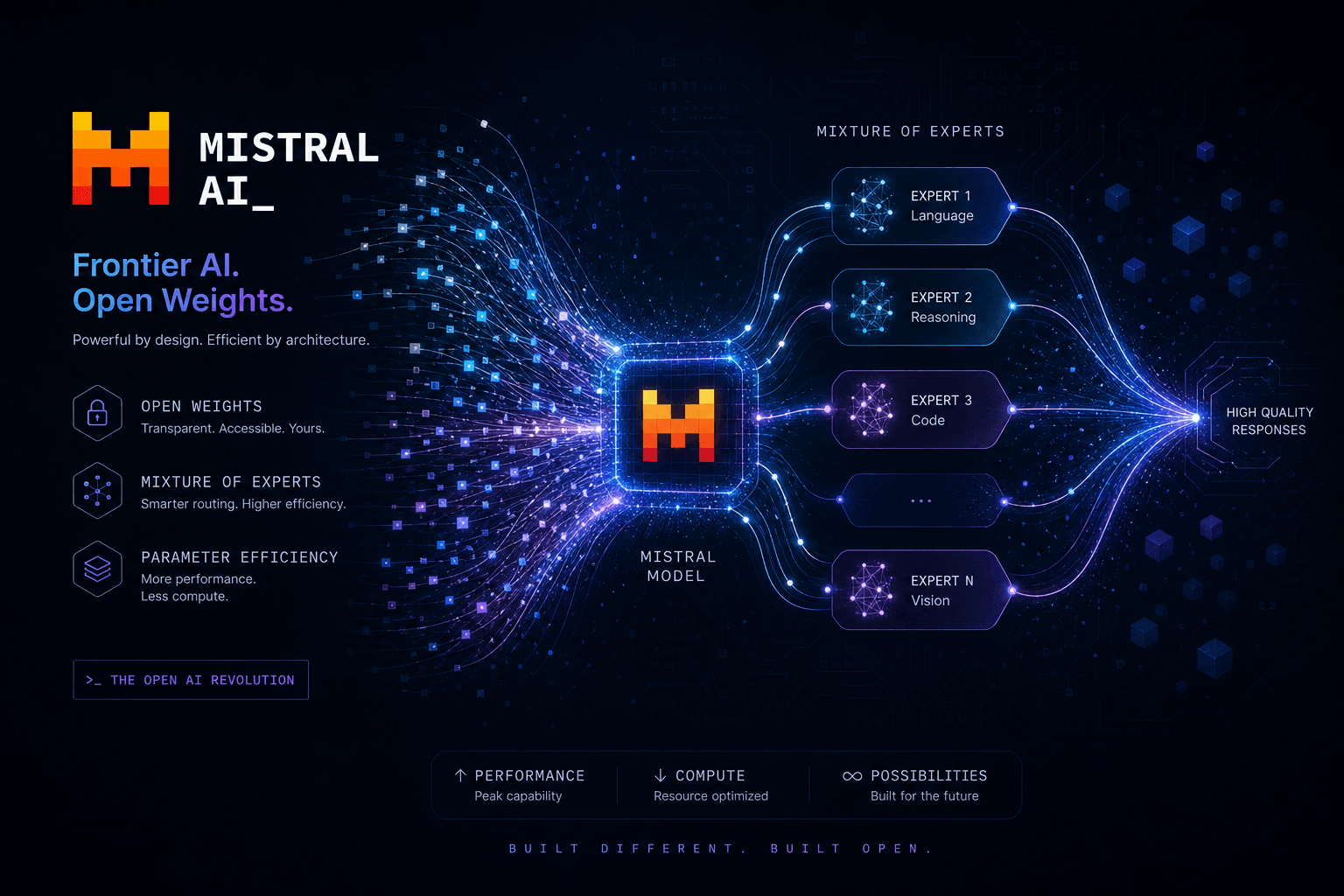
Mixtral 8x7B proved that sparse Mixture of Experts (MoE) architectures could outperform dense models with dramatically lower inference costs, challenging the industry assumption that bigger meant better. Released December 11, 2023, it featured 46.7 billion total parameters but only activated 12.9 billion per token—delivering the quality of a 70B-parameter model at the speed and cost of a 13B model.
What is Mixture of Experts (MoE)? #
Mixture of Experts is an architectural pattern where a model consists of multiple specialized sub-networks (the "experts") and a gating mechanism that routes each input token to a subset of these experts. Unlike dense transformers where every parameter participates in every forward pass, MoE models are "sparse"—only a fraction of parameters are active for any given token.
Mixtral 8x7B implements this with 8 expert networks, each effectively a 7B-parameter transformer. For every token, a learned router network selects the top-2 most relevant experts. The token is processed by both selected experts, and their outputs are combined. This means:
- Each expert specializes in different types of tokens or reasoning patterns
- The router learns to send code-like tokens to code-specialized experts, French to French-language experts, etc.
- The model achieves massive capacity (46.7B parameters worth of knowledge) without massive inference costs
Sparse vs. Dense: The Parameter Efficiency Story #
The parameter efficiency breakthrough of Mixtral 8x7B upended traditional scaling laws. Here's how it compared to dense alternatives in April 2024:
| Model | Total Parameters | Active per Token | Efficiency Ratio | Context Window |
|---|---|---|---|---|
| Mixtral 8x7B | 46.7B | 12.9B | 3.6x | 32K |
| Llama 2 70B | 70B | 70B | 1.0x | 4K |
| GPT-4 (estimated) | ~1.8T | ~220B | ~8x | 8K/32K |
| Mistral 7B | 7.3B | 7.3B | 1.0x | 8K |
The "efficiency ratio" shows how much total parameter capacity the model maintains relative to its active compute cost. Mixtral's 3.6x ratio meant it packed nearly 3.6 times the knowledge capacity per FLOP spent compared to dense models. For production deployments, this translated to serving GPT-3.5-class responses at roughly one-quarter the inference cost of Llama 2 70B.
Benchmark Reality Check:
| Benchmark | Mixtral 8x7B | Llama 2 70B | GPT-3.5 Turbo |
|---|---|---|---|
| MMLU | 70.6% | 69.9% | 70.0% |
| HumanEval | 40.2% | 32.6% | 48.1% |
| GSM8K | 58.4% | 56.8% | 57.1% |
| MT-Bench | 8.30 | 7.40 | 7.94 |
Mixtral matched or exceeded Llama 2 70B on most benchmarks while offering 6x faster inference and the ability to fit on a single A100 80GB GPU. Against GPT-3.5, it achieved parity on MMLU and GSM8K while approaching its coding performance—at a fraction of the API cost for self-hosted deployments.
Real-World Performance and Latency Trade-offs #
Production deployment of MoE models introduced unique considerations that benchmark scores didn't capture:
Memory Requirements: Despite activating only 12.9B parameters per token, Mixtral 8x7B required loading all 46.7B parameters into memory. At FP16 precision, this demanded approximately 90GB of VRAM—meaning it required an A100 80GB with aggressive quantization or multiple GPU setups. This was the primary deployment barrier; unlike Mistral 7B, Mixtral 8x7B wasn't a "laptop-friendly" model.
Throughput Characteristics: The top-2 routing introduced slight overhead—approximately 5–10% latency increase compared to a dense 13B model of equivalent active parameters. However, the massive quality gain more than justified this cost. With optimized inference servers like vLLM or Text Generation Inference (TGI), teams achieved 50–100 tokens/second on A100 hardware.
Expert Load Balancing: In practice, the router didn't distribute tokens perfectly evenly across experts. Certain experts—typically those handling common English vocabulary—saw heavier utilization. This had implications for batch processing: if too many tokens in a batch hit the same expert, memory bandwidth became a bottleneck. Production deployments often used expert parallelism (distributing experts across multiple GPUs) to mitigate this.
Head-to-Head: Open Weights vs. Closed Source #
Mistral models occupied a strategic middle ground in April 2024—delivering GPT-3.5-class performance at local-deployment economics while approaching GPT-4 on specific tasks. The choice between open-weights and closed-source wasn't binary; it was a spectrum where each option dominated specific use cases.
Mistral vs. GPT-3.5 and GPT-4 #
GPT-3.5 Turbo was the primary casualty of Mixtral 8x7B's rise. On standard benchmarks, the two models were statistically tied:
| Capability | Mixtral 8x7B | GPT-3.5 Turbo | Winner |
|---|---|---|---|
| General reasoning (MMLU) | 70.6% | 70.0% | Tie |
| Code generation (HumanEval) | 40.2% | 48.1% | GPT-3.5 |
| Math (GSM8K) | 58.4% | 57.1% | Mixtral |
| Instruction following (MT-Bench) | 8.30 | 7.94 | Mixtral |
| Context window | 32K | 16K | Mixtral |
For most production tasks—RAG pipelines, content summarization, classification—Mixtral 8x7B matched GPT-3.5 while offering 4x the context window (32K vs. 16K at the time). The primary gap remained in code generation, where GPT-3.5's 48.1% HumanEval pass rate still led open-weights alternatives.
GPT-4 remained unchallenged at the top tier. With its estimated 8x MoE architecture and ~1.8 trillion total parameters, GPT-4 achieved 86.4% on MMLU and 67% on HumanEval—substantially ahead of Mixtral's 70.6% and 40.2%. However, GPT-4's $60/$120 per million tokens pricing and API dependency made it a luxury good. Teams reserved GPT-4 for high-stakes reasoning tasks (complex analysis, critical code review) while routing bulk workloads to self-hosted Mistral instances.
Mistral vs. Claude 2 and Claude 2.1 #
Anthropic's Claude 2 carved out a distinct niche through its massive 100,000-token context window—launched in July 2023 and unmatched until Mixtral's 32K context. For document analysis, legal contract review, and book-length summarization, Claude 2 remained the default choice in April 2024.
| Factor | Mixtral 8x7B | Claude 2 | Mistral 7B |
|---|---|---|---|
| Context window | 32K | 100K | 8K |
| API input cost | Self-hosted | $11.02/million | Self-hosted |
| API output cost | Self-hosted | $32.68/million | Self-hosted |
| Safety tuning | Minimal | Extensive | Minimal |
| Creative writing | Good | Excellent | Adequate |
Claude 2's pricing advantage over GPT-4—47% cheaper overall with input costs less than one-fifth of GPT-4—made it attractive for high-volume applications. However, teams handling sensitive data still preferred self-hosted Mistral for privacy. Anthropic's extensive safety tuning also meant Claude 2 was more reluctant to engage with certain prompts, a trade-off that frustrated some power users who valued Mistral's more neutral, unfiltered outputs.
The Economic Case: API Costs vs. Infrastructure Costs #
The financial calculus of April 2024 heavily favored open-weights for predictable, high-volume workloads. Here's a real-world scenario comparing 10 million daily tokens processed through GPT-4 versus self-hosted Mixtral 8x7B:
GPT-4 API Approach (April 2024 pricing):
- 5M input tokens × $60/million = $300/day
- 5M output tokens × $120/million = $600/day
- Monthly cost: ~$27,000
Self-Hosted Mixtral 8x7B:
- Cloud GPU (A100 80GB) × $2.50/hour × 24 hours = $60/day
- Storage, bandwidth, operational overhead ≈ $20/day
- Monthly cost: ~$2,400
Savings: $24,600/month (91% reduction)
The break-even point for self-hosting varied by workload:
- Below ~500K tokens/day: API services (OpenAI, Anthropic) remained cost-effective
- 500K–2M tokens/day: Hybrid approach made sense—API for bursts, local for baseline
- Above 2M tokens/day: Self-hosted open-weights became the clear economic winner
For teams with steady, predictable workloads—customer support chatbots, internal knowledge bases, automated content pipelines—the business case for Mistral was overwhelming. A single engineer could deploy Mixtral 8x7B via vLLM or TGI in an afternoon, and the infrastructure savings funded additional AI initiatives.
Why the Community Embraced MoE #
The AI community's enthusiasm for Mixture of Experts in early 2024 signaled a fundamental shift in how practitioners thought about model scaling—moving from "bigger is better" to "smarter activation is better." Mistral's open-weights release of MoE architectures catalyzed experimentation that had previously been locked behind closed doors at OpenAI and Google.
The "Expert Specialization" Hypothesis #
The central hypothesis driving MoE excitement was that specialized experts would develop distinct competencies, creating emergent capabilities beyond what uniform dense models could achieve. Early analysis of Mixtral 8x7B's experts revealed patterns supporting this theory:
- Expert 1 consistently handled technical syntax—code, markup, structured data
- Experts 2–3 specialized in Romance languages (French, Spanish, Italian)
- Expert 4 dominated English common vocabulary and grammar
- Experts 5–6 handled reasoning and mathematical formulations
- Experts 7–8 managed rare tokens, proper nouns, and multilingual edge cases
This specialization meant the model effectively "knew when to consult a code expert" versus "asking a linguist"—producing more coherent outputs across diverse tasks than a generalist dense model of equivalent active parameters.
The scaling implications were profound. Dense models scaled compute with total parameters (O(n)). MoE models scaled compute with active parameters while growing total knowledge capacity (O(active) vs. O(total)). This suggested a path to models with trillions of parameters that remained inference-efficient—a roadmap Mistral AI had validated with 8x7B.
Open-Source Ecosystem Support #
By April 2024, the open-weights deployment ecosystem had matured dramatically. Tools that had been experimental six months earlier were now production-ready:
vLLM (UC Berkeley) became the default for high-throughput serving. Its PagedAttention algorithm—treating attention key/value caches like virtual memory pages—enabled continuous batching that improved throughput by 20x over naive implementations. Major deployments at Meta, Mistral AI, and Cohere ran on vLLM.
Text Generation Inference (Hugging Face) offered an alternative optimized for safety and feature richness. Built-in token watermarking, structured JSON generation, and granular safety filters made it attractive for enterprise deployments. TGI's FlashAttention integration achieved similar performance to vLLM with better observability.
Ollama democratized local deployment with its "Docker for LLMs" approach. One-command setup (ollama run mixtral), automatic hardware detection, and OpenAI-compatible REST API made it the entry point for developers experimenting with open weights. By April 2024, Ollama had surpassed 100 million cumulative model pulls.
LM Studio served the GUI-preferring segment. Its desktop application wrapped model management, chat interfaces, and headless server mode (added in v0.4.0) into a polished package that required zero terminal interaction.
The Quantization Advantage #
The GGUF format—successor to GGML—made MoE models accessible on consumer hardware through aggressive quantization:
| Quantization | File Size | Quality Retention | Hardware Required |
|---|---|---|---|
| Q4_K_M | ~26GB | ~95% | 2× RTX 4090 or 1× A100 80GB |
| Q5_K_M | ~31GB | ~97% | 2× A100 40GB or 1× A100 80GB |
| Q8_0 | ~48GB | ~99% | 2× A100 80GB |
| FP16 | ~90GB | 100% | 2× A100 80GB or H100 |
Q4_K_M quantization—the sweet spot for many deployments—allowed Mixtral 8x7B to run on dual-consumer-GPU setups or single high-end datacenter cards. The quality degradation was minimal for most applications; instruction-following and reasoning remained strong, with only subtle degradation in creative writing fluency.
The llama.cpp project's relentless optimization meant quantized models ran efficiently on Apple Silicon (M1/M2/M3), AMD GPUs via ROCm, and even CPU-only environments. A MacBook Pro with 64GB unified memory could comfortably run the Q4_K_M variant—enabling mobile development, offline inference, and edge deployment scenarios that API-only models couldn't touch.
The Llama 3 Shadow: What Was Coming #
Meta's Llama 3 release—confirmed for April 18, 2024, just two weeks after this writing—hung over the open-weights landscape like a pending storm. The AI community knew Meta had trained on vastly more compute than Llama 2, expanded data curation, and was preparing models at 8B and 70B scales. The question wasn't whether Llama 3 would disrupt the market; it was how thoroughly Mistral's dominance would be challenged.
Rumored 8B and 70B Variants #
By early April 2024, leaks and official teasers from Meta had established clear expectations:
Llama 3 8B aimed to reclaim the efficiency crown from Mistral 7B. Meta had trained on 15 trillion tokens—7x more than Llama 2's training data—with heavily filtered web data, code repositories, and synthetic reasoning examples. Early chatter suggested it would surpass Mistral 7B's MMLU score (60.1%) while maintaining the 8K context window and Apache 2.0 licensing.
Llama 3 70B targeted GPT-3.5 parity—or better. The expectation was 75%+ on MMLU, improved HumanEval scores, and a potential 128K context window via positional interpolation techniques. Meta's compute advantage—H100 clusters running for months—suggested this would be the first open-weights model to unambiguously surpass GPT-3.5 across the board.
The 400B "Godzilla" Model: Meta confirmed a 400B+ parameter model remained in training. While not part of the April 18 launch, its existence signaled Meta's commitment to the open-weights ecosystem. The community speculated this would approach GPT-4-class performance by mid-2024.
Meta's Infrastructure Advantage #
Meta brought advantages to the open-weights race that startup competitors like Mistral AI couldn't match:
Training Compute: Meta's GPU fleet—hundreds of thousands of H100s—allowed training runs at scales impossible for smaller teams. While Mistral 7B trained on undisclosed but presumably limited resources, Llama 3 leveraged data center-scale infrastructure.
Proprietary Data: Meta's access to Instagram, Facebook, and WhatsApp content—subject to their terms—provided unique training data, particularly for multilingual and conversational contexts. Code from internal Meta repositories and AI-generated synthetic data further enriched the training mix.
Distribution Network: Llama 3's launch partnerships included AWS, Google Cloud, Azure, and Databricks—immediate availability across the enterprise cloud ecosystem. Mistral, while available through Ollama and Hugging Face, lacked equivalent enterprise distribution.
What Mistral Did Right (That Llama 3 Would Need to Match) #
Mistral's six-month reign established standards Llama 3 would be measured against:
Apache 2.0 Licensing: Mistral's unrestricted open-source license enabled commercial use, modification, and redistribution without attribution requirements. The community watched to see if Meta would maintain this or introduce more restrictive terms.
Inference Efficiency: Mixtral 8x7B proved that parameter count wasn't the only metric. If Llama 3 70B required 10x the compute for marginal quality gains, efficiency-conscious teams would stick with Mistral's MoE approach.
Ecosystem Tooling: By April 2024, Mistral models were the reference implementations for vLLM, Ollama, and quantization tools. Llama 3 would need immediate, optimized support across the same toolchain to achieve rapid adoption.
European Independence: For European enterprises concerned about data sovereignty, Mistral AI's EU base provided regulatory comfort. Llama 3's American origins, even with open weights, raised questions about potential future export controls or usage restrictions.
Deployment Patterns: How Teams Used Mistral in Production #
Production deployments of Mistral models in April 2024 fell into three distinct patterns: local-first for privacy-sensitive workloads, fine-tuned for domain-specific applications, and API-wrapped for hybrid architectures. Understanding these patterns reveals how open-weights transitioned from experimentation to infrastructure.
The Local-First Movement #
The "local-first" philosophy—running models entirely on infrastructure you control—gained significant traction through Q1 2024. Three archetypes dominated:
Healthcare and HIPAA Compliance: Medical AI startups chose Mistral 7B for clinical note summarization and diagnostic assistance because patient data never left their VPC. Self-hosting eliminated Business Associate Agreements (BAAs) with third-party AI providers and the associated legal complexity.
Financial Services: Banks and trading firms deployed Mixtral 8x7B for internal research analysis and document processing. The 32K context window handled lengthy SEC filings and earnings transcripts without the compliance risk of sending proprietary financial data to external APIs.
Government and Defense: Agencies with classified or controlled unclassified information (CUI) requirements found Mistral's Apache 2.0 license and self-hosted nature ideal. Air-gapped deployments on secure networks became possible—unthinkable with closed-source alternatives requiring internet-connected API calls.
The common thread: data sovereignty. Organizations that couldn't risk intellectual property, customer data, or regulated information reaching third-party servers chose open-weights by necessity, not preference. Mistral's quality made this choice viable rather than painful.
Fine-Tuning and Adaptation Strategies #
Base Mistral models served as foundations for domain-specific customization. By April 2024, several fine-tuning approaches had matured:
LoRA (Low-Rank Adaptation) became the standard for efficient fine-tuning. Rather than updating all 7.3B or 46.7B parameters, LoRA injected small trainable rank decomposition matrices into attention layers. Fine-tuning a Mistral 7B model for a specific domain required only 1–10% of the base model's VRAM during training and produced adapter weights under 100MB.
QLoRA pushed efficiency further by conducting the entire fine-tuning process in 4-bit quantized space. A consumer RTX 4090 could fine-tune Mistral 7B on custom datasets—a capability that democratized model customization beyond well-resourced AI labs.
Common Fine-Tuning Patterns:
| Use Case | Base Model | Approach | Training Data Size | Typical Result |
|---|---|---|---|---|
| Customer support | Mistral 7B | LoRA | 10K–50K conversations | 40% accuracy improvement on internal tickets |
| Legal analysis | Mixtral 8x7B | Full fine-tune | 100K+ legal documents | Domain-appropriate citations and terminology |
| Medical QA | Mistral 7B | QLoRA | 5K–20K clinical cases | Safe, conservative responses for triage |
| Code completion | Mistral 7B | LoRA | 50K+ internal code files | 25% better internal API recognition |
Direct Preference Optimization (DPO) emerged as an alternative to traditional RLHF for alignment. Rather than training a separate reward model, DPO directly optimized the language model from preference pairs ("response A is better than response B"). This was more stable than RLHF and required less compute, making it practical for smaller teams to create instruction-tuned variants.
The Rise of Model Serving Infrastructure #
The tooling ecosystem around open-weights deployment matured rapidly in early 2024:
Ollama dominated the developer experience layer. Its model registry (ollama pull mixtral), simple CLI, and cross-platform support (macOS, Linux, Windows) made it the default entry point. The Modelfile system allowed teams to define system prompts, temperature settings, and template formats—turning raw checkpoints into production-ready services.
vLLM became the choice for high-throughput API serving. Its continuous batching, PagedAttention memory management, and OpenAI-compatible API server meant teams could swap api.openai.com for localhost:8000 with minimal code changes. Benchmarks showed 10–20x throughput improvements over naive Hugging Face Transformers serving.
Docker and Kubernetes Integration: Pre-built containers for vLLM and TGI simplified deployment to existing infrastructure. Helm charts for Kubernetes auto-scaling emerged, allowing GPU node pools to scale with demand. Teams running on AWS, GCP, or Azure could treat Mistral inference like any other microservice.
The Emerging Gateway Pattern: Tools like LiteLLM and Olla provided unified proxy layers, routing requests between multiple model backends (Ollama, vLLM, OpenAI API) based on load, cost, or capability requirements. This "model gateway" pattern let teams gradually migrate from closed-source to open-weights without application rewrites.
The Bigger Picture: What April 2024 Meant for AI #
The dominance of Mistral 7B and 8x7B in April 2024 marked an inflection point: AI capability had been effectively commoditized. When a startup with fewer than 50 employees could release models matching OpenAI's GPT-3.5—and give them away under Apache 2.0—the balance of power in the AI industry shifted permanently toward openness.
Open Weights as a Strategic Moat #
Forward-thinking companies recognized that proprietary AI wasn't a defensible moat; the moat was in how you used AI. Self-hosted models provided advantages closed-source APIs couldn't match:
Customization Depth: A company fine-tuning Mistral on a decade of internal documents created a model that "thought" in their specific terminology, understood their legacy systems, and reasoned about their domain with fluency no generic API could replicate.
Latency and Availability: Sub-50ms response times and 99.99% uptime became achievable when you controlled the infrastructure. No rate limits, no degradation during peak hours, no dependency on another company's operational excellence.
Cost Predictability: API pricing could change overnight (OpenAI had adjusted pricing multiple times in 2023–2024). Infrastructure costs, while volatile, followed predictable patterns. Finance teams could budget with confidence.
Regulatory Preparedness: As EU AI Act, US executive orders, and industry-specific regulations evolved, self-hosted models offered auditability and control that simplified compliance. You knew exactly what data your model had seen, where inference happened, and how outputs were generated.
By April 2024, Mistral AI had proven that the open-weights path could match—and in some dimensions exceed—the closed-source alternative. This wasn't just about cost savings; it was about strategic autonomy.
The Coming Wave of Efficient Architectures #
Mistral's MoE success foreshadowed broader industry trends that would dominate 2024 and beyond:
Parameter Efficiency Over Scale: The "GPT-4 has 1.8T parameters, we need bigger" arms race gave way to "how do we get GPT-4 quality with 100B active parameters?" Mixtral 8x7B's 3.6x efficiency ratio became a benchmark for new architectures.
Context Length as a First-Class Feature: Mistral's 32K and 8K context options highlighted that long-context reasoning was increasingly important. The ability to process entire codebases, books, or lengthy transcripts in a single pass changed what applications were possible.
Multimodal Open Weights: While Mistral focused on text, the April 2024 landscape showed early open-weights multimodal models emerging. The community anticipated that vision-language models would follow the same open-weights trajectory within 12–18 months.
Edge Deployment: As quantization techniques improved and models shrank (Mistral 7B → hypothetical "Mistral 3B"), running capable models on phones, IoT devices, and edge servers became practical. The future pointed toward distributed AI—intelligence everywhere, not just in data centers.
April 3, 2024, was the moment the industry realized open weights weren't a compromise—they were the future. Llama 3's imminent release would raise the bar, but it would do so within the open-weights paradigm Mistral had validated. The genie was out of the bottle.
FAQ Section #
Q: What made Mistral 7B special compared to other 7B parameter models? #
A: Mistral 7B introduced Sliding Window Attention (SWA) and Grouped-Query Attention (GQA)—architectural innovations that reduced memory usage by 40% and improved inference speed without sacrificing quality. Released September 27, 2023, it achieved 60.1% on MMLU and outperformed Llama 2 13B on all benchmarks while maintaining the Apache 2.0 license.
Q: How does Mixture of Experts (MoE) actually work in Mixtral 8x7B? #
A: Mixtral 8x7B uses 8 expert networks (each ~7B parameters) with a learned router that selects the top-2 experts for each token. This means 46.7B total parameters exist, but only 12.9B are active per forward pass—delivering the quality of a large model at the compute cost of a small one. The router learns to send code tokens to code experts, French to French experts, and so on.
Q: Was Mixtral 8x7B really as good as GPT-4? #
A: No—GPT-4 remained superior with 86.4% MMLU vs. Mixtral's 70.6% and significantly better coding performance. However, Mixtral 8x7B matched or exceeded GPT-3.5 on most benchmarks (70.6% vs. 70.0% MMLU, 58.4% vs. 57.1% GSM8K) at a fraction of the cost, making it the pragmatic choice for production workloads that didn't require GPT-4's peak reasoning capabilities.
Q: Why did developers prefer open-weights models over GPT-4 in 2024? #
A: Three primary drivers: cost economics (91% savings at high volume), data privacy (no third-party API calls for sensitive data), and infrastructure control (predictable latency without rate limits). For teams processing millions of tokens daily or handling regulated data, self-hosted Mistral models eliminated vendor dependency and compliance complexity.
Q: What was Llama 3 expected to change about the open-weights landscape? #
A: Meta's April 18, 2024 Llama 3 release—with 8B and 70B variants trained on 15 trillion tokens—was anticipated to raise the quality bar for open-weights models, potentially surpassing GPT-3.5 comprehensively. Its Apache 2.0 license and immediate cloud availability threatened to shift momentum from Mistral back to Meta's ecosystem, though Mistral's efficiency innovations remained relevant.
Q: How much did it cost to run Mixtral 8x7B compared to GPT-4 API calls? #
A: At 10 million tokens daily, GPT-4 cost approximately $27,000/month ($60/million input, $120/million output). A self-hosted Mixtral 8x7B instance on cloud GPUs cost roughly $2,400/month—a 91% cost reduction. The break-even point typically occurred around 500K–2M tokens/day, depending on infrastructure choices.
Q: Could Mistral 7B run on consumer hardware? #
A: Yes—Mistral 7B was the definition of consumer-friendly. At FP16 it required ~14GB VRAM (fitting an RTX 4090), and quantized to 4-bit (GGUF Q4_K_M) it occupied only ~4.5GB—runnable on MacBook Pros with M-series chips, high-end gaming laptops, and even some smartphones via llama.cpp. This accessibility democratized local AI deployment.
Q: What benchmarks mattered most for comparing open-weights models in 2024? #
A: MMLU (Massive Multitask Language Understanding) measured broad knowledge across 57 subjects. HumanEval tested code generation capabilities. GSM8K evaluated mathematical reasoning. MT-Bench assessed instruction-following and conversational quality. Context window size and inference tokens/second were equally critical for production deployment decisions.
Q: Did Mistral models support fine-tuning for custom use cases? #
A: Yes—both models supported LoRA and QLoRA fine-tuning, allowing domain adaptation with minimal compute. LoRA required only 1–10% of base model VRAM during training, producing adapter weights under 100MB. Teams fine-tuned on customer support conversations, legal documents, medical cases, and internal codebases with 25–40% task-specific accuracy improvements.
Q: What happened to Mistral after Llama 3 was released? #
A: Following Llama 3's April 18, 2024 launch, Mistral AI continued releasing competitive models—Mistral Large, Mistral Small, and Codestral—pivoting toward a dual strategy of open-weights releases and premium API services. The company secured partnerships with Microsoft Azure and raised significant funding, establishing itself as a sustainable European alternative to both OpenAI and Meta rather than a temporary phenomenon.
Conclusion: The Open-Weights Era Had Arrived #
By April 3, 2024, the question was no longer whether open-weights models could compete with closed-source giants—it was how quickly teams would adapt their infrastructure to capture the advantages. Mistral 7B and 8x7B proved that local deployment, data sovereignty, and cost efficiency didn't require sacrificing quality. For the six months between Mixtral's December release and Llama 3's arrival, they were the default choice for builders who wanted AI capability without API dependency.
The legacy of this period extends beyond the specific models. Mistral established that efficient architecture beats brute-force scaling—that Sliding Window Attention, Grouped-Query Attention, and Mixture of Experts weren't academic curiosities but production-ready optimizations. Every model released since, from Llama 3 to the latest Claude and GPT iterations, operates in the shadow of these innovations.
For teams building today, the lessons remain relevant: evaluate models on total cost of ownership, not just benchmark scores. Consider data residency requirements before defaulting to APIs. And remember that the open-weights ecosystem—with tools like vLLM, Ollama, and the ever-expanding quantization frontier—offers capabilities that closed-source platforms can't match.
Need Help Deploying AI in Your Infrastructure? #
Whether you're evaluating open-weights models for your compliance requirements, building self-hosted AI pipelines, or architecting multi-model inference systems, I help teams ship production-grade AI that stays under their control.
Book an AI Automation Strategy Call to discuss:
- Self-hosted LLM deployment architectures (vLLM, Ollama, TGI)
- Fine-tuning strategies for domain-specific models
- Cost optimization and infrastructure sizing
- Hybrid open-weights + API workflows
- n8n automation pipelines with local AI integration
Let's build AI infrastructure that works for your business—not the other way around.
Related Reading:
- The n8n + MCP Integration Guide — Wire self-hosted models into agent workflows
- Claude Code Masterclass — When to use closed-source assistants for development
- The n8n Production Playbook — Automating AI pipelines at scale
Related Posts

AI Sales Agents in 2026: What They Can Do, What They Can't, and When to Deploy One
AI sales agents can research, qualify, sequence outbound, and book calls — but not negotiate or invent trust. Here's what works in 2026 and when to deploy.

AI Chat vs Live Chat: When to Use Each and How to Set Up the Handoff
When to use AI chat vs live chat, how to train the bot on your products and policies, cut support cost without tanking CSAT, and wire a clean human handoff.

How to Build an AI Support Agent That Handles 80% of Tickets Automatically
Build an AI support agent that routes tickets, answers FAQs from your KB, and escalates the rest — the n8n + model stack I use to hit ~80% auto-handle rates.