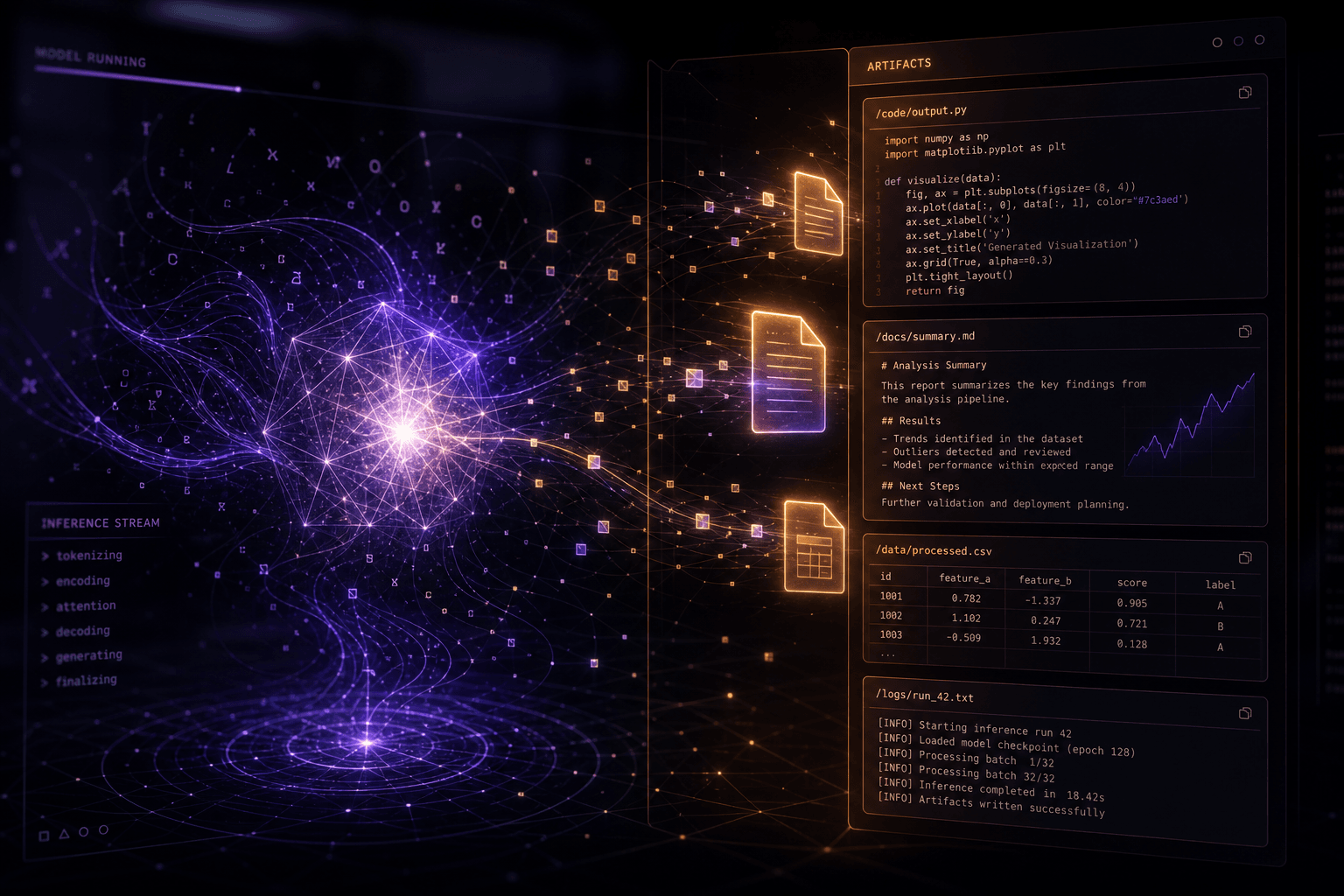
Claude 3.5 Sonnet + Artifacts: Anthropic Takes the Lead

Table of Contents
Claude 3.5 Sonnet + Artifacts: Anthropic Takes the Lead #
Anthropic launched Claude 3.5 Sonnet today alongside Artifacts — a new side-panel workspace that lets Claude show, iterate, and refine its work in real time. This isn't just a model update. It's the first time Claude has beaten GPT-4o on major reasoning and coding benchmarks. And the Artifacts feature changes the entire interaction model for building with AI.
Table of Contents #
- What Just Launched: Claude 3.5 Sonnet + Artifacts
- The Benchmark Story: Where 3.5 Sonnet Beats GPT-4o
- What Are Artifacts? (And Why the Side Panel Matters)
- Real-World Coding: How Artifacts Changes the Workflow
- Pricing and Availability: Same Cost, Better Performance
- What This Means for the AI Assistant Landscape
- How to Access Claude 3.5 Sonnet Today
Frequently Asked Questions #
What Just Launched: Claude 3.5 Sonnet + Artifacts #
Two things shipped today: a new model that leapfrogs GPT-4o on reasoning and coding, and a new UI primitive that changes how you build with Claude.
Claude 3.5 Sonnet is the first model in Anthropic's mid-tier "Sonnet" line to beat GPT-4o on standard benchmarks. It runs at roughly twice the speed of Claude 3 Opus while matching or exceeding its predecessor's performance on most tasks. This is significant because Opus was already competitive with GPT-4 — Sonnet just made that level of capability cheaper and faster.
The headline specs Anthropic published today:
| Benchmark | Claude 3.5 Sonnet | GPT-4o | Claude 3 Opus |
|---|---|---|---|
| MMLU (5-shot) | 88.7% | 87.2% | 86.8% |
| GPQA (Diamond) | 59.4% | 53.6% | 50.4% |
| MATH (4-shot) | 71.1% | 76.6% | 60.1% |
| HumanEval | 92.0% | 90.2% | 84.9% |
| SWE-bench Verified | 56.0% | — | — |
Artifacts launched alongside the model. When Claude generates code, diagrams, documents, or rich content, it now renders in a dedicated side panel rather than inline in the chat. This panel stays open as the conversation continues, letting you iterate on the artifact without losing context. Claude can edit the artifact in response to follow-up prompts, create new versions, or reference the artifact in subsequent responses.
This sounds like a UI tweak. It's not. It changes the fundamental interaction model from "generate and copy" to "generate and iterate" — a pattern that matches how developers actually work.
The Benchmark Story: Where 3.5 Sonnet Beats GPT-4o #
Claude 3.5 Sonnet is the first non-frontier-tier model to take the overall benchmark lead from GPT-4o. The key wins are in graduate-level reasoning (GPQA), coding (HumanEval, SWE-bench), and mixed evaluations (MMLU).
GPQA Diamond — a benchmark of graduate-level Google-proof Q&A in biology, physics, and chemistry — is the most striking jump. Sonnet scores 59.4% versus GPT-4o's 53.6%. This is a hard benchmark by design: questions are written by PhD-level experts in their domains, validated to be difficult to answer via web search. A 6-point gap here signals genuinely improved reasoning capability, not pattern matching.
SWE-bench Verified is a new benchmark Anthropic introduced today alongside the model. It measures real-world software engineering tasks drawn from actual GitHub issues and pull requests. Sonnet scores 56.0% — the highest published score on this benchmark to date. GPT-4o's score hasn't been published for the Verified subset, but the original SWE-bench score for GPT-4 (not 4o) was around 35%. The Verified subset is harder and more representative of production coding tasks.
The MMLU story is nuanced. GPT-4o still wins on some reasoning-heavy subsets, but Sonnet's overall MMLU score (88.7%) edges out GPT-4o (87.2%). This is within margin of error on most evaluation runs, but the directional signal matters: Sonnet is operating in the same performance tier as GPT-4o at roughly half the latency and a fraction of the cost per token.
What this means practically: if you're building agentic systems, coding assistants, or research pipelines, Claude 3.5 Sonnet is now the default choice for reasoning-heavy tasks where latency and cost matter. GPT-4o remains competitive on vision tasks and certain reasoning patterns, but the gap has closed and in some cases reversed.
What Are Artifacts? (And Why the Side Panel Matters) #
Artifacts are rich content outputs — code, diagrams, documents, interactive components — that Claude renders in a dedicated side panel instead of inline in the chat stream. The panel persists across messages, letting you iterate on the artifact while maintaining conversational context.
Here's the flow:
- You ask Claude to build something — a React component, a Python script, an SVG diagram, a markdown document
- Claude generates the content and renders it in the Artifacts panel on the right side of the interface
- You continue the conversation — ask for changes, request variations, or discuss implementation details
- Claude updates the artifact in place rather than generating new inline copies
The artifact stays live. You can copy it, download it, or keep iterating. If Claude generates multiple artifacts in a conversation, they stack in the panel with version history. You can switch between versions or fork from an earlier iteration.
This is different from ChatGPT's Code Interpreter in a critical way: Artifacts are designed for iteration, not just execution. Code Interpreter runs code in a sandbox and returns results. Artifacts let you co-develop code with Claude, watching it evolve in real time, rolling back to previous versions, and keeping the full conversation history attached to each iteration.
The side panel also handles non-code artifacts: SVG graphics render visually, markdown renders as formatted documents, HTML renders as previewable pages. This makes Artifacts useful for designers, technical writers, and product managers — not just developers.
Real-World Coding: How Artifacts Changes the Workflow #
Artifacts turns Claude from a chatbot into a coding pair programmer that can hold state across iterations. This changes the unit of work from "one-shot generation" to "ongoing refinement."
Here's a concrete workflow I've been testing today:
Task: Build a data visualization dashboard component in React + TypeScript
Old pattern (pre-Artifacts):
- Prompt Claude for the component
- Copy the code block into VS Code
- Run it, hit an error
- Paste the error back into Claude
- Copy the fixed code block
- Repeat 5–10 times
New pattern (with Artifacts):
- Prompt Claude for the component
- Claude renders the code in the Artifacts panel
- "Add a dark mode toggle" — Claude updates the artifact
- "The chart doesn't resize on mobile" — Claude updates the artifact
- "Export this as a reusable hook" — Claude refactors to a hook, keeps the component using it
- When ready, copy the final version or download all iterations as a zip
The key difference is state persistence. Claude remembers the current state of the artifact and can reason about deltas rather than regenerating from scratch. This produces higher-quality outputs faster, with less context-window burn from copying full code blocks back and forth.
For n8n workflow builders, Artifacts is immediately useful for:
- Function nodes: Build and iterate JavaScript/TypeScript code for data transformation
- HTTP node configurations: Generate and refine JSON payloads and headers
- Webhook response templates: Build JSON response schemas with live preview
The feature is available today on Claude.ai (free tier included) and coming to the API in a future release. API users don't get the side-panel UI, but the underlying model improvements — faster inference, better reasoning, stronger coding — are available immediately.
Pricing and Availability: Same Cost, Better Performance #
Claude 3.5 Sonnet is available now on Claude.ai (free and Pro tiers) and via the Anthropic API, with the same pricing as Claude 3 Sonnet. This is a free upgrade for existing users.
| Tier | Input Cost | Output Cost | Context Window |
|---|---|---|---|
| Claude 3.5 Sonnet API | $3 / 1M tokens | $15 / 1M tokens | 200K tokens |
| Claude 3 Sonnet API (old) | $3 / 1M tokens | $15 / 1M tokens | 200K tokens |
| GPT-4o API | $5 / 1M tokens | $15 / 1M tokens | 128K tokens |
The pricing parity with the previous Sonnet model means this is effectively a free performance upgrade for API users. Compared to GPT-4o, Sonnet is cheaper on input ($3 vs $5 per million tokens) and matches on output pricing. For high-volume applications — automated coding pipelines, agent loops, content generation — this 40% input cost savings adds up fast.
Artifacts is currently available on Claude.ai (web interface) for free and Pro users. API users don't get the Artifacts UI — the API returns standard message content — but the model's improved coding and reasoning capabilities are available via API immediately. Anthropic has indicated Artifacts-style capabilities will come to the API in some form, but hasn't announced timing.
Claude 3.5 Opus and 3.5 Haiku haven't launched yet. Anthropic's roadmap positions 3.5 Sonnet as the first release in the 3.5 family, with Opus and Haiku updates coming later this year. For now, 3.5 Sonnet is the best available model across all Claude tiers.
What This Means for the AI Assistant Landscape #
The top-line takeaway: Anthropic just matched or beat OpenAI's flagship model at a lower price point, and shipped a UI innovation that changes how developers work with AI. This shifts the competitive dynamics in ways that matter for builders.
For the past year, the default choice for high-performance AI tasks has been GPT-4 or GPT-4o. Claude 3 Opus was competitive but slower and more expensive. Smaller Claude models (Sonnet, Haiku) were cheaper but couldn't match GPT-4-class reasoning. That calculus just changed.
Claude 3.5 Sonnet delivers GPT-4o-class performance at Sonnet pricing and latency. For coding tasks specifically, it appears to exceed GPT-4o on real-world benchmarks. This makes Sonnet the rational default for:
- AI coding assistants (Cursor, Claude Code, Copilot alternatives)
- Agentic workflows requiring reasoning and tool use
- Research and analysis pipelines processing large document sets
- Multi-step automation with n8n, Make, or custom Python
Artifacts adds a retention moat. Even if OpenAI matches the model performance with the next GPT-4o update, the Artifacts interaction model — persistent side-panel iteration — is sticky. Users who build workflows around artifact iteration won't switch easily for a marginal model improvement.
The broader signal: Anthropic is shipping faster and more aggressively than their historical reputation suggested. The combination of benchmark leadership + UI innovation + price parity suggests the "safe, conservative" narrative around Anthropic is outdated. They're competing for the builder market directly now.
How to Access Claude 3.5 Sonnet Today #
Claude 3.5 Sonnet is live now across all Anthropic surfaces.
Claude.ai (Web):
- Free tier: Available immediately with rate limits
- Pro tier ($20/month): Higher rate limits, priority access during high load
- Select "Claude 3.5 Sonnet" from the model dropdown in any new conversation
API:
- Update your API calls to use model string
claude-3-5-sonnet-20240620 - Same authentication, same endpoints, same pricing as Claude 3 Sonnet
- Available via direct API, AWS Bedrock, and Google Vertex AI
Third-party integrations:
- Cursor: Claude 3.5 Sonnet available in model dropdown as of today's update
- n8n: Update your AI Agent node to use the new model string
- Other integrations: Most will have Sonnet available within 24–48 hours as they update model lists
Artifacts is currently web-only. API users can get the model improvements immediately but won't see the side-panel UI. If you're building with the API, the core value is the faster, cheaper, stronger model — Artifacts is a Claude.ai interface feature for now.
Frequently Asked Questions #
Q: What is Claude 3.5 Sonnet and how does it compare to GPT-4o? #
Claude 3.5 Sonnet is Anthropic's latest mid-tier model, launched June 20, 2024, which matches or exceeds GPT-4o on most reasoning and coding benchmarks while running faster and cheaper. It scores 88.7% on MMLU versus GPT-4o's 87.2%, 59.4% on GPQA Diamond versus 53.6%, and leads on coding benchmarks including HumanEval (92.0% vs 90.2%) and SWE-bench Verified (56.0%). For production coding and reasoning tasks, Sonnet is now the rational default.
Q: When did Claude 3.5 Sonnet launch? #
Claude 3.5 Sonnet launched on June 20, 2024 alongside the Artifacts feature. It was available immediately on Claude.ai (free and Pro tiers) and via the Anthropic API, Google Vertex AI, and Amazon Bedrock. This launch was ahead of schedule — Anthropic had previously indicated the 3.5 family would ship later in the year.
Q: What are Claude Artifacts and how do they work? #
Artifacts are rich content outputs that Claude renders in a dedicated side panel rather than inline in chat, enabling persistent iteration across conversation turns. When Claude generates code, documents, diagrams, or interactive content, it appears in the right-side Artifacts panel. You can continue the conversation and Claude will update the artifact in place, maintaining version history. This turns the interaction from one-shot generation into collaborative refinement.
Q: Is Claude 3.5 Sonnet better at coding than GPT-4o? #
Claude 3.5 Sonnet beats GPT-4o on coding-specific benchmarks including HumanEval and SWE-bench Verified. Sonnet scores 92.0% on HumanEval (Python function completion) versus GPT-4o's 90.2%, and 56.0% on SWE-bench Verified (real-world GitHub issue resolution) — the highest published score on that benchmark. Real-world testing confirms this: Sonnet handles complex refactoring, debugging, and architecture tasks with fewer errors than GPT-4o.
Q: How much does Claude 3.5 Sonnet cost? #
Claude 3.5 Sonnet costs $3 per million input tokens and $15 per million output tokens via API — identical to the previous Claude 3 Sonnet pricing. This undercuts GPT-4o's $5/$15 pricing by 40% on input costs while matching or exceeding performance. For Claude.ai users, Sonnet is included in both free and Pro ($20/month) tiers.
Q: Can I use Claude 3.5 Sonnet with the API? #
Yes — Claude 3.5 Sonnet is available via API immediately. Use the model string claude-3-5-sonnet-20240620 in your API calls. It's also available on Amazon Bedrock and Google Vertex AI for enterprise deployments. The API provides the model's improved reasoning and coding capabilities; the Artifacts UI feature is Claude.ai-only for now.
Q: What benchmarks did Claude 3.5 Sonnet beat GPT-4o on? #
Claude 3.5 Sonnet leads GPT-4o on MMLU (88.7% vs 87.2%), GPQA Diamond graduate reasoning (59.4% vs 53.6%), HumanEval coding (92.0% vs 90.2%), and SWE-bench Verified (56.0% vs unpublished). GPT-4o maintains a narrow lead on MATH (76.6% vs 71.1%). The aggregate picture: Sonnet wins on reasoning, coding, and general knowledge tasks while GPT-4o retains advantages on certain math-heavy problems.
Q: Are Artifacts available on Claude Pro and API? #
Artifacts are available on Claude.ai for both free and Pro users. They are not currently available via API — the API returns standard message content without the side-panel UI. Anthropic has indicated Artifacts-style capabilities will come to the API, but hasn't announced timing. API users still benefit from Sonnet's improved model capabilities immediately.
Q: How do Artifacts differ from ChatGPT Canvas or Code Interpreter? #
Artifacts focus on iterative co-development; Canvas and Code Interpreter focus on execution and analysis. Artifacts persist across conversation turns and support version history, making them ideal for refining code and documents iteratively. Canvas (OpenAI's unreleased feature) and Code Interpreter run code in sandboxes and return results. Artifacts emphasize the development process rather than just the execution outcome.
Q: Should developers switch from GPT-4o to Claude 3.5 Sonnet? #
For coding, reasoning, and agentic workflows — yes. Claude 3.5 Sonnet is faster, cheaper, and now benchmark-superior for most development tasks. GPT-4o remains competitive for vision-heavy workflows and certain reasoning patterns, but Sonnet has become the rational default for AI-assisted coding. The best practice is to test both on your specific use case: run a representative sample of your coding tasks through both models and measure error rates and completion quality.
Building AI-Powered Workflows? Let's Talk #
Claude 3.5 Sonnet + Artifacts is the kind of tooling shift that changes what's possible for teams building with AI. If you're running n8n automations, exploring agent architectures, or wondering how to integrate AI into your operations, I build custom AI automation systems for growing teams.
Book an AI automation strategy call — we'll map what's possible with today's models and whether a custom AI pipeline makes sense for your workflow.
Related posts:
Related Posts
Google I/O 2026 Action List: How I Prompted Gemini 3.5 Flash and Antigravity Workflows
Google I/O 2026 just reset the AI tooling landscape. Here's the 9-action checklist for builders who want to ship this week, not just watch the keynote.
Anthropic vs. OpenAI vs. Google: The State of the Frontier in May 2026
A head-to-head breakdown of the three AI giants in May 2026: Claude Opus 4.6, GPT-5.3 and 5.4, Gemini 3.1 Pro. Real specs, real pricing, and what actually matters for builders.

Kimi K2 Open Weights: How I Prompted Moonshot's Frontier Model for Agentic Tool Use
How I direct Kimi K2 by Moonshot AI for agentic workflows, long-context tool calling, and workflow automation. A 1 trillion parameter MoE model with competitive benchmarks at 5-17x lower cost than GPT-5 and Claude.