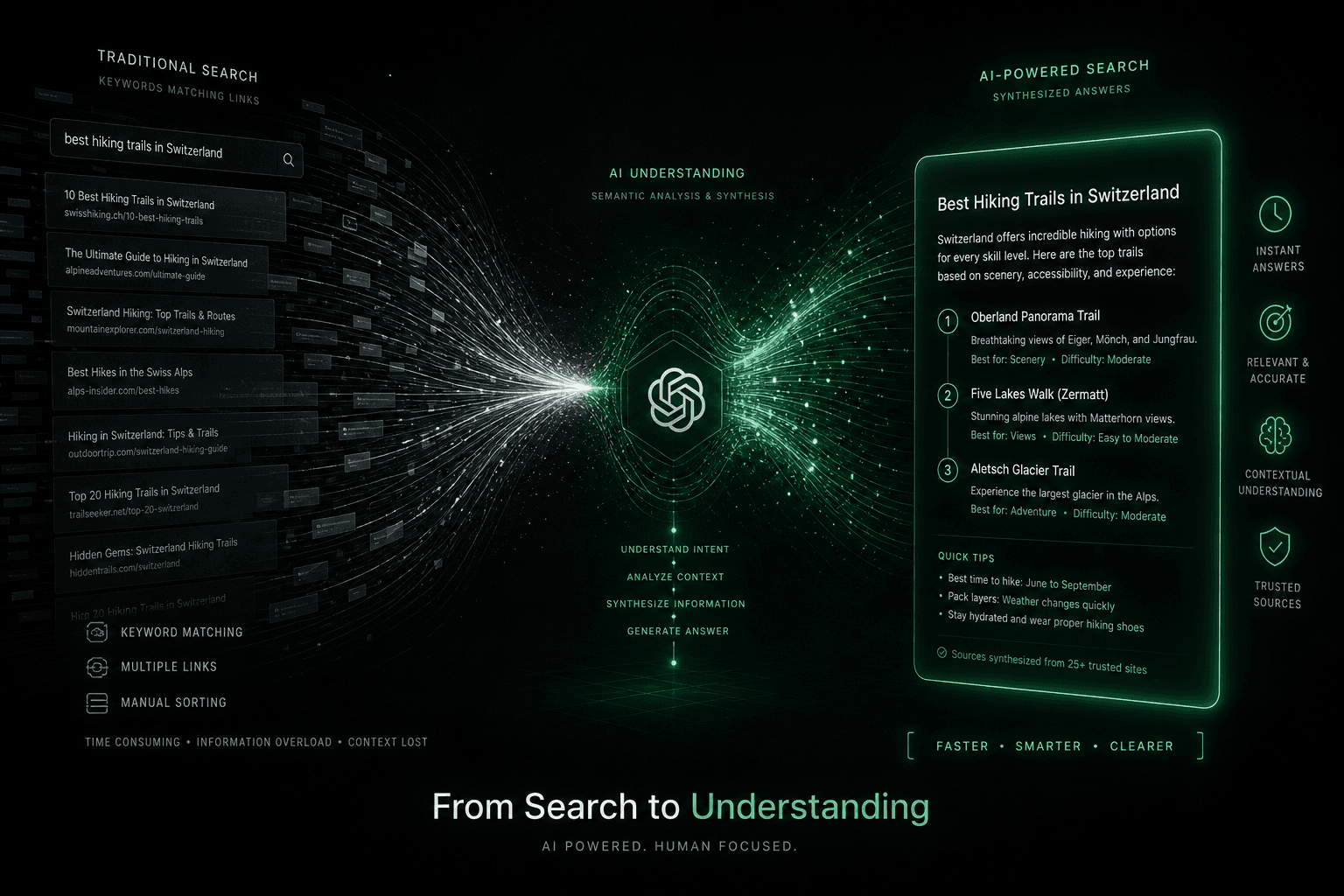
ChatGPT Search Is Live: The First Real Google Challenger in Two Decades

Table of Contents
ChatGPT Search Is Live: The First Real Google Challenger in Two Decades #
OpenAI launches ChatGPT Search today—October 31, 2024—giving ChatGPT real-time web access with inline source citations, conversational follow-ups that preserve context, and a clean, ad-free interface that feels like what Google Search should have become. This is the most significant challenge to Google's search dominance since Bing launched in 2009.
What Just Launched: ChatGPT Search in 60 Seconds #
ChatGPT Search is a real-time web search capability built directly into ChatGPT, combining GPT-4o's conversational intelligence with live search results, inline source citations, and multi-turn sessions that preserve context. OpenAI launched it today—October 31, 2024—making it available immediately to ChatGPT Plus and Team subscribers, plus users on the SearchGPT waitlist.
The core premise is simple but significant: instead of ChatGPT being limited by its training data cutoff, it can now access current information from the web, cite sources inline, and engage in follow-up questions that build on previous search context. The interface is clean, ad-free, and conversational—essentially what Google Search might look like if it were built for the AI era rather than the keyword era.
Key capabilities launching today:
| Feature | What It Does |
|---|---|
| Real-time web search | Queries pull current data from Bing and publisher partnerships |
| Inline citations | Source links appear directly within answers, not buried below |
| Conversational follow-ups | Multi-turn searches retain context across questions |
| Visual results | Weather widgets, stock charts, maps, and news cards |
| Automatic triggering | ChatGPT decides when to search, or users can force it with the web icon |
| Sources sidebar | All referenced sources listed alongside the conversation |
William Spurlock—AI automation engineer and custom web designer—has been testing the SearchGPT prototype since its July 2024 announcement. The full integration exceeds expectations: this is not a separate search product but a fundamental expansion of what ChatGPT can do. The implications extend beyond convenience; this is the first time since Bing's 2009 launch that a credible alternative to Google Search exists.
How ChatGPT Search Actually Works (Technical Overview) #
ChatGPT Search runs on a fine-tuned version of GPT-4o, post-trained using synthetic data generation techniques including outputs from OpenAI's o1-preview model. This is not a simple wrapper around Bing—it is a purpose-built search-native model that decides when to search, what to retrieve, and how to synthesize answers with citations.
The Data Pipeline: From Query to Cited Answer #
The technical architecture follows this path:
Query Classification — GPT-4o analyzes whether the query requires real-time information. Current events, sports scores, stock prices, and weather trigger automatic search. Factual queries within training data may not.
Search Execution — When search is triggered, queries route through multiple providers. Microsoft Bing serves as the primary search infrastructure partner, but OpenAI also integrates content directly from publisher partnerships including Associated Press, Reuters, Financial Times, Condé Nast properties (Vogue, Wired), Time, Le Monde, and Axel Springer (Politico, Business Insider).
Result Synthesis — The model retrieves relevant pages, extracts key information, and generates a response with inline citations. Unlike traditional search that returns links, ChatGPT Search returns synthesized answers with source attribution.
Citation Generation — Sources appear as clickable links within the text and in a dedicated sidebar. The citation format varies—sometimes inline numbered references, sometimes direct hyperlinks—depending on content type.
Context Preservation — Follow-up questions maintain the search context from previous turns. Ask about "Apple's earnings" then "what about their iPhone revenue" and the system understands the relationship.
What Model Powers the Search? #
According to OpenAI's technical documentation, the search model is GPT-4o fine-tuned specifically for retrieval-augmented generation (RAG) with web sources. The training process included:
- Synthetic data generation using o1-preview outputs
- Post-training on web-specific reasoning tasks
- Optimization for citation accuracy and source relevance
The Bing Partnership Explained #
Microsoft's Bing provides the underlying search index and infrastructure. OpenAI's help documentation confirms that search query and location data are shared with Microsoft when using ChatGPT Search. This is a continuation of the strategic partnership that began with Microsoft's $10 billion investment in OpenAI and powers Bing's own Copilot features.
However, the implementation differs significantly:
| Aspect | Bing Copilot | ChatGPT Search |
|---|---|---|
| Interface | Integrated into Bing search results | Native ChatGPT experience |
| Citation style | Sources in sidebar | Inline + sidebar |
| Model | GPT-4 via Microsoft partnership | Fine-tuned GPT-4o |
| Follow-up depth | Limited context retention | Full conversational memory |
| Ads | Present | None |
Visual and Interactive Results #
Beyond text answers, ChatGPT Search renders:
- Weather widgets with current conditions and forecasts
- Stock charts with real-time price data and time-range selection
- Maps with location context
- News cards with headlines and source attribution
- Sports scores with live updates
These elements render natively within the chat interface, eliminating the need to click through to external sites for basic information.
ChatGPT Search vs Google vs Perplexity: The Head-to-Head Comparison #
ChatGPT Search, Google, and Perplexity represent three fundamentally different approaches to finding information online—generation-first versus keyword-first versus retrieval-first. Understanding their architectural differences reveals when each excels and where each falls short.
The Philosophical Divide #
| Engine | Core Philosophy | Primary Strength |
|---|---|---|
| ChatGPT Search | Generate an answer, then cite sources | Conversational depth with context retention |
| Google Search | Index everything, rank by relevance | Comprehensive coverage and speed |
| Perplexity | Search first, synthesize from retrieved sources | Source transparency and research accuracy |
Detailed Comparison Matrix #
| Factor | ChatGPT Search | Google Search | Perplexity |
|---|---|---|---|
| Speed | Fast (1-3 seconds) | Instant (<1 second for results) | Moderate (2-4 seconds) |
| Answer format | Conversational paragraph | List of links | Synthesized summary with numbered citations |
| Citation style | Inline links + sidebar | None (you visit pages) | Numbered inline citations |
| Follow-up questions | Excellent — full context retention | Poor — each query is isolated | Good — maintains some context |
| Coverage breadth | Limited by search partners | Unmatched — entire web indexed | Moderate — focused on quality sources |
| Ads | None | Extensive (responsible for >$200B revenue) | Minimal (subscription model) |
| Accuracy for facts | Good with occasional hallucinations | N/A — provides sources, not answers | Best — retrieval-first reduces hallucination |
| Use case fit | Research, exploration, content creation | Broad discovery, quick lookups | Deep research, fact-checking |
When to Use Each Engine #
Use ChatGPT Search when:
- You need to explore a topic through multiple related questions
- You want a synthesized answer rather than ten blue links
- You're researching something that requires follow-up clarification
- You prefer an ad-free, conversational interface
- Current information is needed but absolute citation precision is secondary
Use Google Search when:
- You need the broadest possible index of content
- Speed is critical (sub-second results)
- You're searching for something very specific (exact product, address, phone number)
- You prefer evaluating sources yourself rather than trusting a synthesis
- Local search results matter (restaurants, services nearby)
Use Perplexity when:
- Source verification is paramount
- You're conducting academic or professional research
- You need transparent, numbered citations to specific passages
- You want a "search-first" approach that minimizes model hallucination
- You value Perplexity's focus on high-quality sources over breadth
ChatGPT Search's Unique Advantages #
Context Preservation Across Multi-Turn Sessions
Ask: "What are the latest developments in AI regulation?"
Follow-up: "Which of those laws affect small businesses?"
Follow-up: "How do I comply if I use ChatGPT for customer service?"
ChatGPT Search maintains the thread—Google resets with each query. This conversational persistence changes how research gets done.
Content Generation + Search Hybrid
ChatGPT Search can search for information, then immediately use that information to generate content: summarize a news story, draft an email based on current events, or compare multiple sources in a formatted analysis. Google finds the sources; ChatGPT Search does something with them.
Ad-Free by Design
Google's search business generates over $200 billion annually from advertising. ChatGPT Search launches with no ads, no sponsored results, and no incentive to keep users clicking rather than answering. Whether this remains sustainable is an open question—but today, the user experience is notably cleaner.
What Makes ChatGPT Search Different from Standard ChatGPT #
ChatGPT Search eliminates the knowledge cutoff limitation while preserving the conversational interface—but it also introduces new failure modes around source reliability and answer confidence that standard ChatGPT does not have. Understanding these differences matters for anyone relying on ChatGPT for professional or research purposes.
What Changes with Search Enabled #
| Capability | Standard ChatGPT | ChatGPT Search |
|---|---|---|
| Knowledge recency | Cutoff date (varies by model version) | Real-time, current as of today |
| Sports scores | Cannot answer | Live scores with context |
| Stock prices | Outdated or unknown | Real-time charts and prices |
| Weather | Generic climate info | Current conditions + forecast |
| Breaking news | Unaware | Accessible with source links |
| Source citations | None (trained on data, not citing it) | Inline links to live web sources |
| Product pricing | Likely outdated | Current with retailer links |
What Stays the Same #
- Conversational style — Same GPT-4o personality and interaction pattern
- Multi-turn memory — Context retention works identically within a conversation
- Content generation abilities — Can still write, code, analyze, and create
- Safety guardrails — Same content policies and refusal behaviors
- Model capabilities — Reasoning, analysis, and synthesis skills unchanged
New Limitations Introduced by Search #
Standard ChatGPT's limitations are known and predictable: it cannot answer anything past its training date. ChatGPT Search introduces different failure modes:
Source quality variance — The model may cite unreliable sources without clear indication of authority. A blog post and a Reuters article may appear similarly in citation format.
Retrieval errors — The search may miss relevant recent information, or retrieve outdated versions of pages cached by Bing.
Synthesis hallucinations — Even with sources, the model may misinterpret or misrepresent what the sources actually say when synthesizing an answer.
Citation inconsistency — Not every factual claim receives a citation. The system decides what to cite, and those decisions may not match user expectations.
Recency bias — Fresh content may be prioritized over authoritative content, leading to less reliable sources for established facts.
When to Enable Search vs. Stay Offline #
Use standard ChatGPT (search disabled) when:
- Answering questions about established knowledge (history, science, established facts)
- Code generation and technical explanations
- Creative writing and brainstorming
- You need the fastest possible response
- Source citation is not important
Enable ChatGPT Search when:
- Current information is essential (news, prices, scores)
- You need source links for verification
- Research requires exploring multiple angles through follow-ups
- You want visual elements (charts, maps, weather widgets)
The web search icon in the interface allows manual control. Users can force a search even when ChatGPT would not automatically trigger one, or conversely, stick to the knowledge base when recency does not matter.
Real Use Cases: Where ChatGPT Search Wins (and Where It Doesn't) #
ChatGPT Search excels in four specific domains: multi-step research, current event tracking, product comparison shopping, and travel planning—while struggling with hyperlocal queries, highly specific technical documentation lookup, and situations where source authority is ambiguous. Real-world testing reveals clear strengths and weaknesses.
Use Case 1: Research and Deep Information Gathering #
The scenario: Preparing a market analysis on the competitive AI search landscape for a client presentation.
ChatGPT Search approach:
- Initial query: "What AI search products launched in 2024 and how do they compare?"
- Follow-up: "What are the specific launch dates for each?"
- Follow-up: "Which publishers have partnered with OpenAI for ChatGPT Search?"
- Follow-up: "Summarize this into a competitive matrix"
Why it wins: The conversational flow allows rapid iteration without losing context. Each follow-up builds on previous answers. Google would require reformulating complete queries each time. Perplexity handles this well but with less fluid integration into content generation.
Where it struggles: When specific authoritative sources are required for citation (academic papers, legal precedents), Perplexity's more rigorous citation format proves superior.
Use Case 2: Current Events and Breaking News #
The scenario: Tracking an unfolding story—say, an election result or corporate earnings announcement.
ChatGPT Search approach:
- Query: "What happened in today's tech earnings?"
- Response includes synthesized summary with links to CNBC, Reuters, and company press releases
- Stock charts render inline for mentioned companies
Why it wins: Speed of synthesis. Rather than visiting five news sites and synthesizing mentally, ChatGPT Search provides a summary with immediate access to source verification. The visual stock charts and weather widgets eliminate the need for separate app visits.
Where it struggles: Very recent events (within hours) may not be indexed yet. During fast-moving stories, the synthesis can lag behind live updates on news sites or Twitter/X.
Use Case 3: Shopping and Product Comparison #
The scenario: Researching a major purchase—laptop, camera, software subscription.
ChatGPT Search approach:
- Query: "What are the best laptops for video editing in late 2024?"
- Follow-up: "How does the MacBook Pro M4 compare to the Dell XPS 15 for Premiere Pro?"
- Follow-up: "What are current pricing and availability?"
Why it wins: Conversational refinement replaces iterative searches. Standard Google shopping requires multiple separate queries and manual comparison. ChatGPT Search maintains the product context across questions and can synthesize spec comparisons.
Where it struggles: Specific local pricing, inventory availability, and retailer-specific deals may not be current. Google Shopping and dedicated price comparison sites remain superior for transaction-ready purchasing decisions.
Use Case 4: Travel Planning #
The scenario: Planning a trip with weather-dependent activities.
ChatGPT Search approach:
- Query: "What's the weather forecast for Kyoto this weekend?"
- Weather widget displays with 5-day forecast
- Follow-up: "What indoor activities would you recommend if it rains?"
- Follow-up: "Are there any festivals or events happening this weekend?"
Why it wins: Integrated weather widgets plus contextual follow-ups. The model understands the relationship between weather concerns and activity recommendations—something that requires multiple separate searches on Google.
Where it struggles: Real-time transit information, restaurant availability, and booking integrations are not present. Dedicated travel apps and Google Maps remain essential for execution-phase travel planning.
Where ChatGPT Search Currently Falls Short #
| Weakness | Example | Better Alternative |
|---|---|---|
| Hyperlocal queries | "Best coffee shop within 2 blocks of my current location" | Google Maps |
| Specific documentation lookup | "What is the exact syntax for React useEffect cleanup functions?" | Official docs + Google |
| Transactional search | "Buy iPhone 16 Pro Max 256GB Pacific Blue" | Apple Store, Amazon |
| Highly specific long-tail | "1987 Suzuki Samurai carburetor rebuild kit part numbers" | Google (broader index) |
| Source authority verification | "What does the actual study say about this health claim?" | Perplexity (better citation) |
Accuracy, Hallucinations, and the Source Citation System #
ChatGPT Search reduces but does not eliminate hallucination risk—the model can still generate inaccurate information, cite sources incorrectly, or fail to cite claims that need verification. Understanding these failure modes is essential for responsible use.
How the Citation System Works #
ChatGPT Search employs two citation formats:
- Inline citations — Superscript numbers or direct hyperlinks within the answer text linking to specific sources
- Sources sidebar — A dedicated panel listing all referenced sources with titles and URLs
The technical process:
- The model retrieves web pages through Bing and publisher partnerships
- It extracts relevant passages and associates them with claims in the generated answer
- Citations are attached based on model confidence that a source supports a specific claim
- Not all claims receive citations—the system makes judgment calls about what needs sourcing
Hallucination Risks Specific to Search #
Retrieval hallucinations occur when the model claims a source says something it does not. The citation exists, but the interpretation is wrong. This is particularly dangerous because the presence of a citation creates false confidence.
Synthesis hallucinations happen when combining information from multiple sources. The individual sources may be accurate, but the model's synthesis creates a conclusion neither source supports.
Citation omission is when the model states facts without citing sources, and those facts turn out to be wrong. Unlike standard ChatGPT where users know answers come from training data, search-enabled answers feel more authoritative—making uncited claims more likely to be trusted.
What OpenAI Has Disclosed About Accuracy #
OpenAI's documentation acknowledges these limitations:
- ChatGPT Search "may not always provide accurate or complete information"
- Users should "verify important information from reliable sources"
- The model "may not cite all sources used to generate an answer"
The company partnered with established publishers (Reuters, AP, Financial Times) specifically to improve source quality, but the model can still retrieve and cite lower-quality sources from the broader web.
Best Practices for Verification #
Click citations for critical claims — Do not trust that a citation supports what the model claims it supports. Verify the source directly.
Check source authority — A claim cited to a personal blog requires different scrutiny than the same claim cited to a major news outlet.
Watch for missing citations — Claims presented as facts without source links should be treated with the same skepticism as standard ChatGPT output.
Cross-reference important information — For consequential decisions, use multiple search tools and compare answers.
Understand recency bias — Fresh sources may be prioritized over authoritative ones. A breaking news blog may outrank an established reference.
Comparison: How Perplexity Handles This Differently #
| Aspect | ChatGPT Search | Perplexity |
|---|---|---|
| Citation density | Selective (system decides) | Comprehensive (retrieval-first) |
| Citation format | Mixed (inline links + sidebar) | Consistent numbered references |
| Answer generation | Generate first, cite during | Retrieve first, synthesize from sources |
| Hallucination risk | Moderate (generation-first) | Lower (retrieval-first) |
| User transparency | Lower (what sources were considered?) | Higher (clear provenance chain) |
Perplexity's "search-first" architecture inherently reduces hallucination because the model only synthesizes from what it retrieved. ChatGPT Search's "generation-first" approach can introduce model knowledge not present in retrieved sources, increasing error risk.
The Business Model Question: Why No Ads (Yet)? #
ChatGPT Search launches without advertising—a deliberate contrast to Google's $237 billion annual search ad revenue—but this ad-free state is almost certainly temporary strategic positioning rather than a permanent business model. Understanding the economic realities clarifies what users can expect long-term.
The Google Comparison #
Google's 2024 search advertising revenue represents approximately 58% of Alphabet's total revenue. Search is the most profitable business in internet history. Every Google search results page is engineered to maximize ad clicks, often at the expense of organic answer quality.
Google's search economics (2024 figures):
- ~$237 billion in search ad revenue
- ~5.9 trillion searches annually
- ~$0.04 revenue per search query
- Average revenue per user: significantly higher in commercial queries
ChatGPT Search's current economics:
- Subscription-based (Plus at $20/month, Team at higher tiers)
- No per-query advertising
- Costs: GPT-4o inference + Bing search API fees + publisher partnership costs
- Higher per-query cost than traditional search due to LLM generation overhead
Why Launch Without Ads? #
OpenAI's ad-free approach serves multiple strategic objectives:
- User habit formation — Establishing ChatGPT Search as the clean, helpful alternative before introducing friction
- Differentiation — The most obvious contrast with Google is the absence of ads; leading with this builds brand positioning
- Data collection — Understanding what users search for and what answers satisfy them, without ad click optimization distorting behavior
- Competitive moat — Once users experience ad-free search, returning to ad-heavy Google results feels like a downgrade
- Publisher goodwill — Launching with publisher partnerships rather than scraping for ad-supported answers builds content ecosystem relationships
The Inevitable Monetization Question #
Search is expensive. Running GPT-4o queries for every search with live web retrieval costs significantly more than serving static search results. The current subsidy from subscription revenue cannot scale to hundreds of millions of users.
Probable future monetization paths:
| Approach | Likelihood | User Impact |
|---|---|---|
| Sponsored answers | High | AI-generated responses promoting advertisers |
| Affiliate integration | High | Product recommendations with referral links |
| Premium tier expansion | Medium | More features for higher-paying tiers |
| API monetization | Medium | Search as a service for developers |
| Publisher revenue share | Medium | Compensation for content creators |
OpenAI has not announced specific ad products, but CEO Sam Altman's public statements have acknowledged that advertising models are "not off the table."
The Publisher Partnership Strategy #
OpenAI's launch-day publisher deals (Associated Press, Reuters, Financial Times, Condé Nast, Time, Le Monde, Axel Springer) represent a different approach to content economics:
- License content rather than scrape it
- Build relationships with authoritative sources
- Create citation visibility that drives traffic to partners
- Establish precedent for content creator compensation
This positions ChatGPT Search as a partner to publishers rather than a competitor—a contrast to Google's increasingly antagonistic relationship with content creators and the broader "Google is killing the open web" narrative.
What the Ad-Free Period Means for Users #
Today, ChatGPT Search offers a genuinely superior user experience to Google for many queries—no sponsored results cluttering the top, no SEO-optimized thin content ranking above authoritative sources, no need to click through ad-laden pages to find basic information.
This will not last indefinitely. The economics are unsustainable. But the ad-free launch window establishes user habits and brand loyalty that may persist even when monetization arrives. Google's dominance was built in an era when search was also ad-free; by the time ads became ubiquitous, user habits were locked in.
What This Means for Publishers, SEO, and Content Creators #
ChatGPT Search represents both an existential threat and a potential opportunity for web publishers—it could reduce click-through traffic while simultaneously creating new citation-based visibility models. The implications for content strategy, SEO, and publisher economics are profound and uncertain.
The Traffic Threat #
Traditional search sends visitors to websites. AI search answers questions directly, potentially eliminating the need to visit source sites. This is the core threat:
Google's current model:
- User searches → sees list of links → clicks relevant result → publisher gets traffic → publisher monetizes via ads/subscriptions
ChatGPT Search's model:
- User searches → receives synthesized answer with citations → may click source link → publisher gets limited, qualified traffic
Early estimates suggest AI search could reduce publisher traffic by 20-40% for informational queries if users find answers sufficient without clicking through. The economics of content creation depend on traffic; less traffic means less revenue.
The Visibility Opportunity #
However, ChatGPT Search also creates new visibility mechanisms:
- Citation prominence — Being cited in a ChatGPT answer may carry more authority than ranking #5 on Google page one
- Qualified traffic — Users who do click citations are pre-qualified, having already received context from the AI summary
- Long-tail access — Niche expertise can be surfaced even without traditional SEO dominance
- Publisher partnerships — Direct relationships with OpenAI may guarantee visibility regardless of algorithmic ranking
SEO Strategy Implications #
What becomes less important:
- Keyword optimization for ranking position (ChatGPT does not "rank" pages)
- Meta description optimization for click-through rates
- Schema markup for rich snippets (ChatGPT synthesizes rather than displaying structured data)
- Backlink quantity (citation quality may matter more than quantity)
What becomes more important:
- Authority signals — Being recognized as a credible source by language models
- Citation-worthiness — Content structured in ways that AI can easily cite and synthesize
- Freshness — Recent, updated content may be prioritized for current queries
- Direct relationships — Publisher partnerships may bypass traditional search economics
The Google AI Overlays Precedent #
Google's own AI Overview feature (launched May 2024) provides a preview of what publishers fear: AI-generated summaries that appear above search results, reducing click-through rates. Early data suggested 15-25% traffic reduction for affected queries.
ChatGPT Search goes further—there are no "results" to click below the AI answer, only citations within and beside it.
Content Strategy Adaptations #
Publishers and content creators should consider:
- Optimize for citation, not just ranking — Clear, quotable statements; well-structured facts; authoritative sourcing
- Build brand authority — Model training and retrieval systems favor recognized authoritative sources
- Diversify traffic sources — Reduce dependence on any single search engine
- Direct audience relationships — Email newsletters, direct traffic, and owned platforms become more valuable
- Evaluate OpenAI partnerships — For larger publishers, direct licensing deals may be preferable to being scraped
The Ethical and Economic Unanswered Questions #
- Should AI companies compensate publishers for training on their content?
- Should citations be mandatory for all factual claims?
- What happens to the "open web" if AI answers replace site visits?
- How do smaller publishers compete when AI systems favor established brands?
These questions lack clear answers today. The industry is in flux. ChatGPT Search's publisher partnership approach suggests OpenAI recognizes these concerns, but whether this scales to a sustainable ecosystem for content creation remains to be seen.
Same Day: Anthropic Drops Claude Desktop Apps for macOS and Windows #
The AI platform wars intensify today as Anthropic launches native Claude desktop applications for macOS and Windows—coinciding exactly with ChatGPT Search's rollout. This is not coincidence; this is coordinated competitive signaling in a rapidly consolidating market.
What Anthropic Released Today #
Anthropic's desktop applications provide:
- Native macOS and Windows apps — Electron-based, available as free downloads from anthropic.com
- Cross-platform sync — Chat history, starred conversations, and settings sync with web and mobile versions
- File upload support — Drag-and-drop document analysis directly from the desktop
- Keyboard shortcuts — System-native shortcuts for rapid access
- Free tier access — Available to both free users and Claude Pro subscribers
Notably, the desktop apps do not include Anthropic's recently announced "Computer Use" feature—that capability, which allows Claude 3.5 Sonnet to control desktop environments by viewing screens and clicking buttons, remains API-only for now.
The Timing Is Not Random #
Launching on the same day as ChatGPT Search sends a clear market signal: Anthropic intends to compete aggressively for multi-modal AI access. The two companies are positioning for different but overlapping territory:
| Company | Today's Launch | Strategic Focus |
|---|---|---|
| OpenAI | ChatGPT Search | Web-native, search-integrated, real-time |
| Anthropic | Claude Desktop | Desktop-native, productivity-focused, cross-platform |
The Desktop AI Battleground #
AI assistants are becoming operating system-level infrastructure. The competition now extends across:
- Mobile apps — ChatGPT and Claude both have iOS/Android apps
- Web interfaces — Both available in browsers
- Desktop apps — Now both have native desktop clients
- API access — Both offer developer APIs
- Enterprise integrations — Teams, Slack, custom deployments
The goal is ubiquity: be wherever the user is, whenever they need assistance.
What Claude Desktop Means for ChatGPT Search #
These are complementary rather than directly competitive products, but they reveal divergent strategies:
- OpenAI is betting on search integration—being the answer engine for web-connected queries
- Anthropic is betting on work environment integration—being the assistant for document analysis, coding, and desktop productivity
Users will likely use both: ChatGPT Search for web-connected research, Claude for deep document work and coding assistance.
The Broader Platform War Context #
Today's dual launches occur against a backdrop of rapid consolidation:
- Microsoft integrates OpenAI deeply into Copilot, Bing, and Windows
- Google pushes Gemini across Search, Workspace, and Android
- Amazon develops Alexa + Claude integrations
- Apple prepares its own AI integration (Apple Intelligence launched in beta this summer)
The platform war is not about who has the best model—it's about who controls the access points. Today, OpenAI and Anthropic both expanded their surface area.
The Bigger Picture: Is This the Beginning of the End for Google Search? #
ChatGPT Search is not the end of Google Search, but it is the beginning of genuine competition—something Google has not faced in its core search business for over a decade. Measured analysis suggests disruption is likely but displacement is not imminent.
Google's Defensive Moat #
Google maintains several structural advantages that will not erode quickly:
| Advantage | Description | Durability |
|---|---|---|
| Index size | Google's web index remains the most comprehensive | High—years of crawling investment |
| Speed | Sub-second result delivery | Medium—AI search is catching up |
| Local search | Maps, business listings, reviews integration | High—data network effects |
| User habits | Default search behavior across billions | Medium—younger users more adaptable |
| Distribution | Chrome, Android, iOS default status | High—contractual lock-in |
| Ads infrastructure | $237B in advertiser relationships | High—switching costs for buyers |
The reality: Google processes approximately 8.5 billion searches daily. ChatGPT Search launches today to a fraction of that user base. The gap is massive.
Why ChatGPT Search Could Succeed Anyway #
Historical platform shifts often follow a pattern: the incumbent has overwhelming resources but fails to adapt because adaptation threatens its core business model.
Google's innovator's dilemma:
- AI-native search is genuinely better for many queries
- But Google's ad business requires clicks, not answers
- Every improvement that keeps users on Google reduces ad revenue
- Google cannot fully embrace AI search without cannibalizing its cash cow
ChatGPT Search has no such constraint. It can optimize purely for answer quality because it has no legacy ad business to protect.
The Most Likely Scenario: Bifurcation #
Rather than ChatGPT Search replacing Google, the market likely bifurcates:
| Query Type | Winner | Reason |
|---|---|---|
| Informational/research | ChatGPT Search, Perplexity | Better synthesis, no ads |
| Navigational | Knows where everything is | |
| Transactional/commercial | Ad ecosystem, buyer intent | |
| Local | Maps data, business listings | |
| Quick facts | Either | Speed parity emerging |
| Deep research | Perplexity | Superior citation rigor |
Google retains the high-monetization queries (commercial, local) while losing the low-monetization informational queries to AI competitors. This is still a significant revenue threat—informational queries drive volume and ad impressions even if individually less valuable.
Historical Parallels #
Bing's 2009 launch was the last "Google killer." It gained market share slowly, peaked around 20% in some markets, and settled into a stable second place. It did not kill Google, but it did prove that search could support multiple viable competitors.
The mobile transition (2007-2012) threatened Google's desktop dominance but Google adapted—acquiring Android, integrating search deeply into mobile, and maintaining dominance.
The AI transition may be different because it threatens the fundamental business model, not just the access point.
The 5-Year Outlook #
Conservative prediction: Google remains dominant with 60-70% search market share, ChatGPT Search and Perplexity capture 15-25% combined, Bing holds steady at 10-15%.
Aggressive prediction: Google drops to 40-50% as AI-native search becomes default for younger demographics, creating a genuine multi-polar search market for the first time since the 2000s.
William Spurlock's assessment: The aggressive scenario is more likely than consensus acknowledges. The user experience gap is real, younger users have no Google loyalty, and Google's inability to fully embrace answer-engine search due to ad revenue concerns creates a structural opening that OpenAI can exploit.
Who Gets Access and How to Enable It #
ChatGPT Search is available immediately to ChatGPT Plus subscribers ($20/month), Team plan users, and those on the SearchGPT waitlist—free users will gain access over the coming months. Enterprise and education customers receive priority rollout in the weeks ahead.
Current Availability (October 31, 2024) #
| User Type | Access Status | How to Enable |
|---|---|---|
| ChatGPT Plus | ✅ Available today | Automatic—look for web search icon |
| ChatGPT Team | ✅ Available today | Automatic for all team members |
| SearchGPT waitlist | ✅ Available today | Check email for access notification |
| Enterprise | 🔄 Rolling out in weeks | Admin console will show when available |
| Education | 🔄 Rolling out in weeks | Institution admins receive notification |
| Free tier | 📅 Coming months | No specific date announced |
How to Use ChatGPT Search #
Once enabled in your account, ChatGPT Search operates in two modes:
Automatic triggering:
- Ask about current events, weather, sports scores, stock prices, or recent news
- ChatGPT automatically detects queries requiring real-time information
- The globe icon in the interface indicates a web search occurred
Manual triggering:
- Click the web search icon (globe symbol) in the message input area
- This forces a search even for queries that might not automatically trigger one
- Useful for verifying recent information on any topic
Geographic Availability #
ChatGPT Search is available in all regions where ChatGPT operates, with the same geographic restrictions:
- Full access: US, UK, Canada, Australia, most of Europe, Japan, and other supported markets
- Limited or no access: China, Russia, Iran, North Korea, and other restricted regions
The feature respects the same content policies and safety guardrails as standard ChatGPT.
The Chrome Extension #
OpenAI released a Chrome extension alongside the ChatGPT Search launch that:
- Makes ChatGPT Search the default search engine in Chrome
- Redirects address bar searches to ChatGPT
- Provides quick-access shortcuts from the browser toolbar
The extension is available from the Chrome Web Store and requires ChatGPT Plus/Team/waitlist access to function.
What to Expect as a New User #
First-time users should note:
- Not every query searches the web — ChatGPT decides when real-time information adds value
- Citations appear inconsistently — Some claims have inline links, others do not
- Follow-ups are powerful — The context preservation across questions is the feature's standout capability
- Speed is good but not instant — Expect 1-3 seconds for answers vs. Google's sub-second results
- Sources vary in quality — From major publishers to random blogs; evaluate authority
FAQ: ChatGPT Search #
Q: What is ChatGPT Search and how is it different from regular ChatGPT? #
A: ChatGPT Search is a new capability that gives ChatGPT real-time access to the web with inline source citations. Regular ChatGPT is limited by its training data cutoff and cannot answer questions about current events, recent news, stock prices, or weather. ChatGPT Search uses a fine-tuned GPT-4o model to retrieve live information from Bing and publisher partnerships, then synthesizes answers with clickable citations.
Q: How does ChatGPT Search compare to Google Search? #
A: ChatGPT Search prioritizes synthesized answers with conversational follow-ups, while Google prioritizes comprehensive link indexes. ChatGPT Search wins for research and multi-step queries with its context retention and ad-free interface. Google wins for speed, local search, and coverage breadth. ChatGPT Search feels like having a research assistant; Google feels like a library index.
Q: Is ChatGPT Search better than Perplexity? #
A: Each excels in different areas. Perplexity is superior for source transparency and research accuracy due to its retrieval-first architecture and rigorous numbered citations. ChatGPT Search wins for conversational depth, content generation integration, and the broader ChatGPT ecosystem. Choose Perplexity for fact-checking; choose ChatGPT Search for exploration and synthesis.
Q: How does ChatGPT Search technically work? #
A: ChatGPT Search uses a fine-tuned GPT-4o model post-trained with synthetic data from o1-preview outputs. When you ask a question, the system classifies whether it needs real-time information. If so, it queries search providers (primarily Microsoft Bing plus direct publisher partnerships), retrieves relevant pages, extracts key information, and generates a synthesized answer with inline citations. Follow-up questions maintain context from previous turns.
Q: Does ChatGPT Search use Bing? #
A: Yes—Microsoft Bing is the primary search infrastructure partner. OpenAI's documentation confirms that ChatGPT Search shares query and location data with Microsoft. However, the implementation differs from Bing Copilot: ChatGPT Search uses a purpose-built fine-tuned model and integrates content directly from publisher partnerships (Reuters, AP, Financial Times, Condé Nast, and others) alongside Bing's index.
Q: Can I trust the sources cited by ChatGPT Search? #
A: Trust but verify. ChatGPT Search provides inline citations to sources, but citation quality varies from major publishers to personal blogs. The model can misinterpret sources, omit citations for important claims, or retrieve outdated cached versions. Best practice: click through to citations for consequential information and evaluate source authority independently.
Q: What types of queries work best with ChatGPT Search? #
A: ChatGPT Search excels at multi-step research, current event tracking, product comparisons, and travel planning. It struggles with hyperlocal queries (best nearby coffee shop), highly specific technical documentation lookups, and transactional searches (buy this specific product). Use it when you need synthesized information with the ability to ask follow-up questions; use Google for quick lookups and local discovery.
Q: Will ChatGPT Search have ads? #
A: No ads at launch, but advertising is likely in the future. OpenAI has not announced specific ad products, but CEO Sam Altman has stated advertising is "not off the table." The current ad-free experience is subsidized by subscription revenue (Plus at $20/month, Team at higher tiers), but the economics suggest monetization will eventually be necessary for scale.
Q: How do I get access to ChatGPT Search? #
A: ChatGPT Search is available today for Plus subscribers, Team users, and SearchGPT waitlist members. Enterprise and education users receive access in the coming weeks. Free tier users will gain access over the coming months—no specific date announced. Once enabled, the web search icon appears in your ChatGPT interface; searches trigger automatically for current information or manually via the globe icon.
Q: What about Claude desktop apps—are they related to ChatGPT Search? #
A: Anthropic launched Claude desktop apps for macOS and Windows on the same day as ChatGPT Search—October 31, 2024—but they are separate products from different companies. The timing signals intensifying competition in AI platform access. ChatGPT Search focuses on web-connected answers; Claude desktop focuses on desktop productivity and document analysis. Many users will likely use both tools for different purposes.
Q: Does ChatGPT Search replace the need for traditional search engines? #
A: Not entirely—at least not yet. ChatGPT Search complements rather than replaces Google for most users today. Google remains superior for local search, hyper-specific queries, and situations where you want to evaluate multiple sources yourself rather than trusting an AI synthesis. However, for research and informational queries, ChatGPT Search represents a genuine alternative that many users may prefer.
Q: How will ChatGPT Search affect website traffic and SEO? #
A: Expect reduced traffic for informational queries as users find answers without clicking. Early estimates suggest 20-40% traffic reduction for affected content. However, cited sources may receive more qualified, pre-interested visitors. SEO strategies should shift toward authority building and citation-worthiness rather than pure ranking optimization. Publishers should also explore direct partnerships with OpenAI, as established media companies have done.
The AI Landscape Is Reshaping How We Find Information #
ChatGPT Search launching today marks a genuine inflection point—the first credible alternative to Google Search in fifteen years, and a signal that AI-native interfaces will increasingly replace keyword-based discovery. For builders, marketers, and founders, this is not just a new tool but a preview of how information access is being fundamentally reimagined.
The implications extend beyond consumer search. The same RAG (Retrieval-Augmented Generation) architecture powering ChatGPT Search is being deployed in enterprise knowledge bases, customer support systems, and internal research tools. The technology to connect language models to live data sources—via Bing, internal databases, or custom APIs—is becoming infrastructure-grade.
What This Means for Your Business #
If you run a content-driven business, e-commerce operation, or SaaS platform, the shift to AI search requires strategic adaptation:
- Content must be citation-worthy — optimize for AI synthesis, not just keyword ranking
- Direct user relationships matter more — reduce dependence on search traffic alone
- AI-powered research becomes standard — your customers are already using these tools
- Multi-modal presence is essential — be findable across traditional search, AI search, and direct channels
The businesses that thrive in this transition will be those that treat AI search as an opportunity to build authority and direct relationships, not just a traffic threat to be feared.
Related Reading #
- Google AI Overviews Launch: What the Search Pivot Means for Publishers
- GPT-4o Launch: OpenAI's Omni Model and the Free Tier Expansion
- Perplexity vs. ChatGPT: The AI Search Engine Comparison
Build with AI or Build a Digital Experience That Stands Out #
The launch of ChatGPT Search is one more signal that AI is becoming infrastructure—woven into how we work, search, and build. Whether you're looking to automate operations with custom AI agents or create a flagship web experience that converts, the tools and expertise to make it happen are available now.
🤖 AI Automation + Growth #
Custom AI agents, n8n workflows, and MCP-powered automations that handle research, lead generation, content pipelines, and operational tasks—built specifically for your business requirements.
Book an AI automation strategy call →
🎨 Custom Web Design + Digital Experiences #
5-figure full-stack websites with cinematic scroll experiences, WebGL heroes, and conversion-optimized architecture. For brands and founders who need a digital presence that justifies premium positioning.
Start a custom website project →
William Spurlock is an AI automation engineer and custom web designer based in the United States. He writes about frontier AI tools, workflow automation, and premium web experiences.
Related Posts
Google I/O 2026 Action List: How I Prompted Gemini 3.5 Flash and Antigravity Workflows
Google I/O 2026 just reset the AI tooling landscape. Here's the 9-action checklist for builders who want to ship this week, not just watch the keynote.
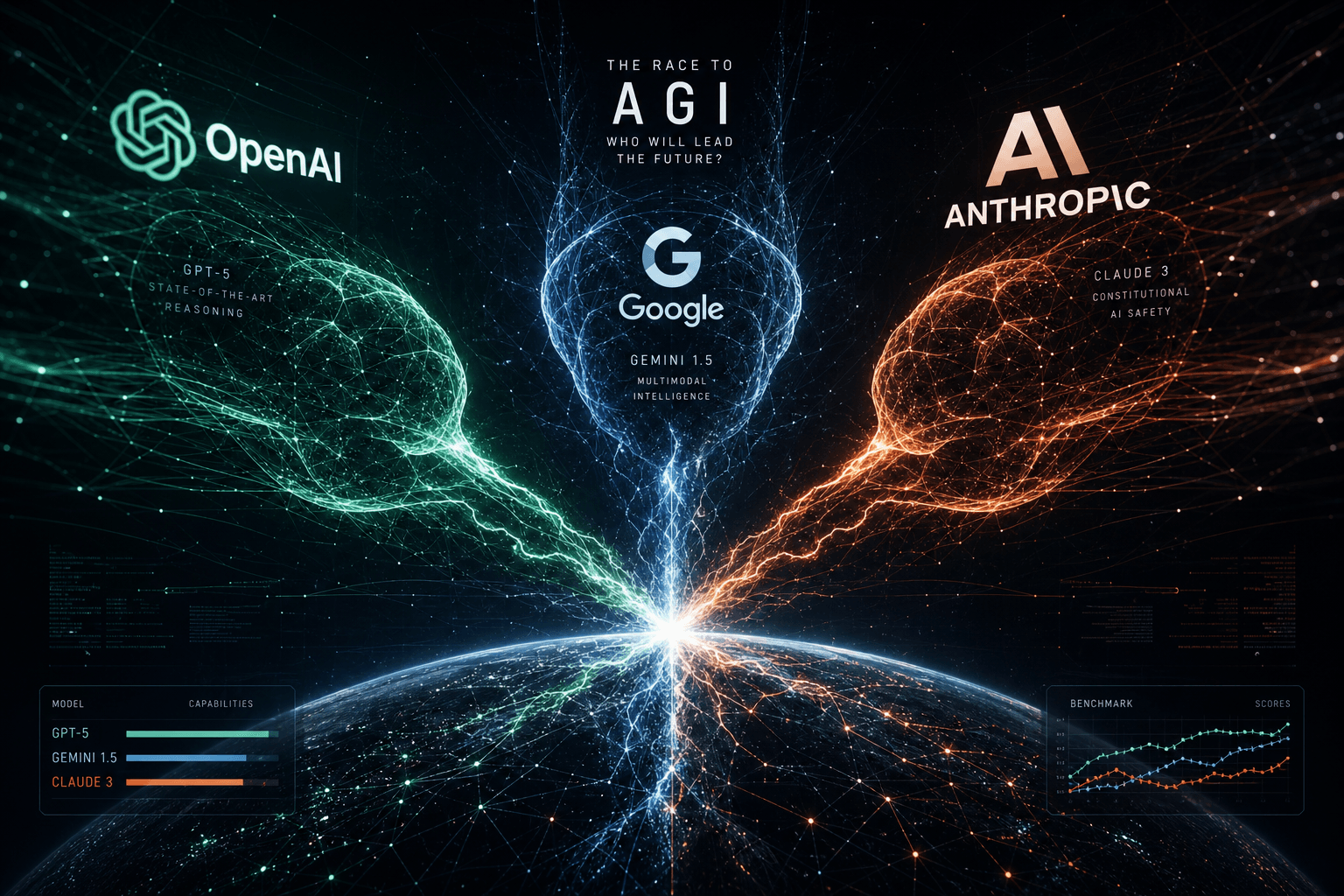
Anthropic vs. OpenAI vs. Google: The State of the Frontier in May 2026
A head-to-head breakdown of the three AI giants in May 2026: Claude Opus 4.6, GPT-5.3 and 5.4, Gemini 3.1 Pro. Real specs, real pricing, and what actually matters for builders.
Kimi K2 Open Weights: How I Prompted Moonshot's Frontier Model for Agentic Tool Use
How I direct Kimi K2 by Moonshot AI for agentic workflows, long-context tool calling, and workflow automation. A 1 trillion parameter MoE model with competitive benchmarks at 5-17x lower cost than GPT-5 and Claude.